

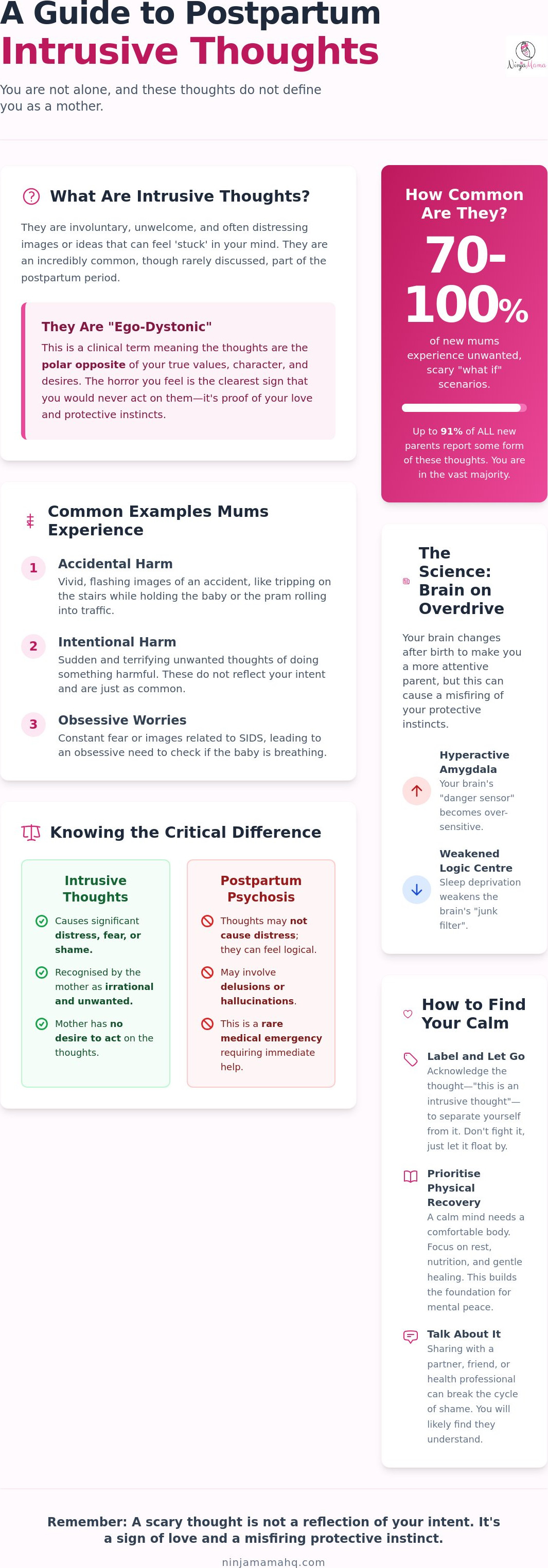
Did you know that between 70 and 100 per cent of new mums experience scary, unwanted images or "what if" scenarios popping into their heads? These intrusive thoughts are one of motherhood’s most guarded secrets, often kept hidden behind a wall of shame and the terrifying fear that speaking up might mean losing your baby. You are physically exhausted. Your body is still healing. Suddenly, your mind starts playing a horror movie you never asked to see. It feels isolating, but the truth is that almost every parent sitting in the parents' group with you has likely felt the exact same way.
We want you to know right now that you aren’t alone. These thoughts do not define who you are as a parent. Having a scary thought is not the same as having an underlying desire to act. In this guide, we will help you understand why these thoughts happen, how to distinguish them from actual intent, and how to find your calm again. We will walk through the science of these misfired protection instincts and share practical, gentle ways to lower your anxiety levels so you can focus on your recovery with confidence.
Key Takeaways
- Recognise that these unwelcome images are "ego-dystonic," meaning they are actually the polar opposite of your true character and desires as a mum.
- Understand why your brain's protection instinct can sometimes misfire, resulting in intrusive thoughts that are driven by postpartum hyper-vigilance.
- Learn the vital distinction between the distress caused by scary thoughts and the clinical signs of postpartum psychosis to help quiet your fears.
- Master practical "Label and Let Go" techniques to acknowledge anxiety without letting it control your daily routine or interactions.
- Discover how prioritising physical comfort and healing after birth provides the essential foundation your mind needs to regain a sense of peace.
What Are Postpartum Intrusive Thoughts? (And Why They Don't Make You a Bad Mum)
You’re sitting on the sofa, nursing your bub, and out of nowhere, a terrifying image flashes across your mind. It is graphic, uninvited, and leaves your heart racing. If this has happened to you, please take a deep breath and listen closely: you aren’t "losing it," and you certainly aren’t a bad parent. These experiences are known as intrusive thoughts, and they are an incredibly common part of the fourth trimester. Recent studies have found that a staggering 95.8 per cent of postpartum women experience thoughts of accidental harm to their infant, while up to 91 per cent of all new parents report some form of these "scary thoughts."
To put it simply, What Are Intrusive Thoughts? They are involuntary, unwelcome ideas or mental images that feel "stuck" in your brain. In the context of motherhood, they often revolve around something terrible happening to your baby. While they feel like a threat, they are actually "ego-dystonic." This is a fancy way of saying they are the exact opposite of your true character, values, and desires. The very fact that these thoughts horrify you is the strongest evidence that you are a safe, loving, and protective mum.
To better understand this concept and why these thoughts don't mean your baby is in danger, watch this helpful video:
Common Examples Mums Experience
Intrusive thoughts often fall into a few specific categories that can feel incredibly isolating if you don't realise others are feeling them too. Many mums report "accidental harm" thoughts, such as a vivid image of tripping while carrying the bub up the stairs or the pram rolling into traffic. Others experience "intentional harm" thoughts, which are sudden, terrifying flashes of doing something hurtful. These are often the most shameful to talk about, but they are just as common and just as meaningless. Finally, many parents face constant images related to SIDS, leading to an obsessive need to check if the baby is still breathing every few minutes.
Why These Thoughts Feel So Real
When an intrusive thought hits, it often triggers what experts call the "whoosh" effect. This is a sudden spike of adrenaline and anxiety that makes your brain treat the mental image like a real-world warning or a premonition. Because the feeling is so intense, your brain becomes "sticky," dwelling on the thought to try and "solve" or prevent it. Ironically, the more you try to push the thought away, the more frequently it returns. Understanding that a thought is just a firing of neurons, and not a reflection of your intent, is the first step toward finding your calm again. Your horror is not a red flag; it is proof of your goodness.
The Science Behind the 'Scary Thoughts': Why Your Brain Is on Overdrive
Ever wondered why your mind feels like it has been completely rewired since bringing your bub home? It’s because, biologically speaking, it has. During the fourth trimester, your brain undergoes significant structural changes designed to make you a more attentive parent. While these shifts are amazing, they can also leave you vulnerable to intrusive thoughts. The emotional processing centre of your brain, known as the amygdala, actually becomes more active and sensitive after birth. This is your internal smoke alarm. Its job is to scan for danger, but in the postpartum period, it can become so hypersensitive that it starts "detecting" threats that aren't actually there.
While your amygdala is screaming "danger," your prefrontal cortex, the part of the brain responsible for logic and filtering out "junk" thoughts, is likely struggling. This is largely due to the extreme sleep deprivation that comes with a newborn. When you haven't had a solid block of rest in weeks, your brain’s ability to dismiss a weird or scary thought is severely weakened. Add to this the most dramatic hormonal crash a human can experience, as oestrogen and progesterone levels plummet within hours of delivery, and you have a perfect storm. These shifts directly impact neurotransmitters like serotonin, which is why your mood can feel so fragile and your thoughts so loud.
The Protection Instinct Misfiring
Your brain is essentially running "worst-case scenario" simulations. It thinks it is helping you stay prepared. If you imagine the bub falling, your brain believes it is reminding you to hold them tighter. Because you are a "good protector," your mind is simply over-performing its duties. Your brain is essentially a security guard who is over-tired and over-zealous. Understanding the difference between Intrusive Thoughts vs. Postpartum Psychosis is vital here; these thoughts are a sign that your protection system is on high alert, not that it is broken.
The Exhaustion Factor
Being "knackered" is more than just feeling sleepy. It physically changes how you process information. When your body is also dealing with the physical discomfort of birth recovery, your nervous system stays in a state of "high alert." A body in pain is a body that feels under threat, which keeps the mind spinning in circles. Taking small steps to support your physical healing, such as using instant perineal cooling pads, can help lower that overall "threat" signal. When your body feels more comfortable and safe, it becomes much easier for your mind to find its way back to a place of calm.
Intrusive Thoughts vs. Postpartum Psychosis: Knowing the Difference
The biggest hurdle to speaking up about these scary images is the terrifying fear that you are "going crazy" or that someone will take your baby away. It is the question that keeps you awake at 3 am: "Am I a danger to my bub?" We want to give you some peace of mind right now. There is a massive, fundamental difference between having intrusive thoughts and experiencing postpartum psychosis. While the first is an incredibly common, though distressing, part of the new-mum experience, the second is a rare medical emergency that requires immediate clinical intervention.
According to research on postpartum intrusive thoughts, these mental glitches are "ego-dystonic." This is just a clinical way of saying they feel like a foreign object in your mind. They are the opposite of what you want. In contrast, postpartum psychosis involves a break from reality where the thoughts feel "ego-syntonic," or consistent with your beliefs at that moment. In psychosis, a person might not feel distressed by the thought, which is why it is so much more dangerous. If you are horrified by the thought, you are firmly in the "intrusive thought" camp.
The 'Horror' Test
If the thought makes you feel sick, terrified, or want to hide, it is an intrusive thought. Mums who experience these images often go to great lengths to ensure their baby is safe. You might avoid the kitchen because of the knives or refuse to walk near the stairs while holding your bub. This avoidance is actually proof of your protective nature. You are so vigilant about your baby's safety that your brain is over-simulating every possible danger. You aren't "thinking" these things because you want them; you are thinking them because you are desperate to prevent them.
Red Flags for Professional Support
While most scary thoughts are just "brain junk," there are times when you need to reach out for a helping hand. If the thoughts start to feel "right," or if they feel like instructions rather than scares, please talk to a professional immediately. Other red flags include feeling paranoid, hearing voices, or being completely unable to sleep even when your bub is settled. In Australia, we are lucky to have incredible resources like PANDA (Perinatal Anxiety & Depression Australia). They understand exactly what you are going through and can help you navigate these feelings without judgment. Remember, asking for help is the most "Ninja Mama" thing you can do for your family.
Practical Strategies to Manage Intrusive Thoughts at Home
Once you understand that your brain is simply over-performing its protective duties, the next step is learning how to handle those 2 am "brain glitches" without letting them spiral. Managing intrusive thoughts isn't about stopping them from happening entirely. It is about changing how you react when they arrive. When a scary image flashes through your mind, your goal is to become a bored observer rather than a terrified participant. By lowering the emotional "volume" of these thoughts, you eventually teach your brain that they aren't worth the energy of a panic response.
One of the most effective tools is the "Label and Let Go" technique. The moment a distressing image appears, name it out loud or in your head. Say, "That is an intrusive thought," or "There is my over-zealous security guard again." By labelling the experience, you create a tiny bit of space between yourself and the image. This prevents you from immediately falling into the "whoosh" of anxiety. You aren't agreeing with the thought; you are simply acknowledging that a mental event has occurred without giving it any moral weight.
Changing Your Relationship with the Thought
Visualisation can be a powerful way to let these images pass through your mind without getting "stuck." Many mums find comfort in the "leaves on a stream" method. Imagine each scary thought is a leaf falling into a gentle river; you are simply sitting on the bank, watching it float out of sight. You can also try the "So What?" method. When your brain presents a terrifying scenario, respond with a shrug. "Okay, brain, thanks for the simulation. So what? I'm busy changing a nappy." A thought is merely a mental event, not a moral compass or a future prediction.
Lowering Your Cortisol Baseline
Your mental resilience is directly tied to your physical state. When you are in pain or physically overwhelmed, your nervous system stays in a state of high alert, making intrusive thoughts feel much more threatening. Establishing a "Self-Care Minimum" can help lower your baseline stress. This might mean five minutes of quiet time or a sensory grounding ritual to signal safety to your body. Using a Ninja Mama Sitz Soak is a wonderful way to combine physical healing with a few moments of mental peace. The warmth and scent provide immediate sensory feedback that you are safe and cared for.
It is also vital to avoid the trap of "avoidance." If you start avoiding the kitchen because you're scared of knives, or refuse to walk near the stairs, you are accidentally telling your brain that those things *are* dangerous. This actually feeds the fear loop. Instead, try to continue your routine while acknowledging the thought is there. It takes practice, but showing your brain that you can handle the thought without changing your behaviour is the fastest way to find your calm again. To help support your overall physical and emotional transition, you can explore our curated postpartum recovery bundles designed to make those early weeks feel more manageable.
The Mind-Body Connection: How Physical Recovery Supports Mental Calm
It is incredibly difficult to practice mindfulness or grounding techniques when your body is in constant physical distress. Mental resilience isn't just about willpower; it is built on a solid foundation of physical comfort. When you are dealing with persistent stinging, soreness, or the raw discomfort of birth recovery, your brain receives a continuous stream of "threat" signals from your nervous system. This keeps your mind in a state of high alert, which is exactly the environment where intrusive thoughts tend to thrive and feel most terrifying. By prioritising your physical healing, you are essentially telling your brain that the immediate "emergency" of birth is over, allowing your mental filters to start working properly again.
Proper nourishment and hydration also play a massive role in how your brain functions during the fourth trimester. Your brain needs stable fuel to regulate your mood and manage the neurotransmitters that keep anxiety at bay. When you are physically "sorted" and your basic needs are met, you regain the mental bandwidth required to dismiss "brain junk" for what it is. At Ninja Mama, we view our products as more than just recovery gear. They are tools for peace, designed to lower the volume of physical noise so you can find your way back to a place of confidence and calm.
Reducing the 'Threat' Signals
Small, practical changes to your daily routine can have a huge psychological impact. For many mums, the simple act of using an upside-down peri bottle to stop the sting of urination can significantly lower daily stress levels. It turns a moment of potential dread into one of relief. Similarly, managing physical inflammation with perineal ice packs does more than just soothe sensitive tissue. It actively signals to your over-active amygdala that your body is safe and healing. There is also immense psychological relief in feeling prepared. Having everything you need tucked away in a postpartum recovery kit provides a sense of order and control that is incredibly grounding when everything else feels chaotic.
Nurturing the Whole Mum
Self-care in the early weeks isn't about spa days; it is about the small rituals that anchor your day. Taking a few minutes to prepare a Booby Booster chocolate drink is an act of self-love that supports both your body and your spirit. When your physical recovery is supported, you aren't just healing your body; you are protecting your mental wellbeing. You are doing a brilliant job, and it is okay to ask for the tools you need to make this transition easier. These intrusive thoughts are a temporary passenger on your journey. As your body grows stronger and more comfortable, your mind will follow. This phase will pass, and you will find your calm again.
Finding Your Path Back to Calm
Navigating the early weeks of motherhood is a monumental transition. It's perfectly normal for your mind to feel as exhausted as your body. Remember, those distressing images are just a misfired protection instinct. They don't define your character or your capability as a parent. By understanding that intrusive thoughts are a common experience for nearly all new mums, you've already taken the biggest step toward lowering your anxiety.
Focus on the small wins. Use the "Label and Let Go" technique during those late-night feeds. Prioritise your physical recovery to signal safety to your nervous system. When you feel physically supported, your mind has the space it needs to settle. You aren't alone in this journey, and you don't have to navigate it without the right tools.
Take the stress out of your recovery with Ninja Mama’s supportive postpartum range. Our collection is designed by mums for mums, offering Australian-owned and expert-backed support for your fourth trimester.
You are doing a wonderful job. This season is intense, but it is also temporary. Trust your instincts, be gentle with yourself, and know that you've got this.
Common Questions About Postpartum Intrusive Thoughts
Are intrusive thoughts a sign of postpartum depression?
Not necessarily. While they can co-occur with postpartum depression, these "scary thoughts" are more frequently linked to postpartum anxiety or obsessive-compulsive disorder. Many mums experience them without feeling the low mood or lethargy typically associated with depression. It is often more about your brain being stuck in a loop of high-alert protection rather than a reflection of your overall mood or mental state.
Can I be left alone with my baby if I have these thoughts?
Yes, it is generally safe for you to be alone with your bub. Because these images are distressing and unwanted, they are not a reflection of your intentions or a desire to cause harm. In fact, mums who have these thoughts are often extra careful because they are so focused on safety. If the thoughts ever start to feel "right" or like instructions, that is when you should seek immediate help from a healthcare professional.
How long do postpartum intrusive thoughts typically last?
Most parents find that these thoughts decrease significantly as they move further away from the fourth trimester. Data suggests that thoughts of accidental harm often peak around five to six weeks postpartum, while thoughts of intentional harm are most intense within the first eight weeks. For the majority of women, these symptoms resolve or become much more manageable by the six-month mark as hormones settle and sleep improves.
Should I tell my midwife or partner about my scary thoughts?
Sharing your experience with a trusted midwife, GP, or partner is one of the fastest ways to reduce the shame that keeps these thoughts "stuck." Speaking the words out loud often strips the thought of its power. If you are worried about their reaction, you can start by saying, "I'm having some common but scary postpartum thoughts that I need to talk about." This helps frame the conversation around a known biological experience.
What is the best way to stop an intrusive thought in the moment?
The most effective way to handle an intrusive thought in the moment is to acknowledge it without trying to fight it. When you fight a thought, you give it more energy and importance. Instead, try saying to yourself, "This is just a weird brain glitch, and I’m letting it float past like a cloud." Taking a slow breath and focusing on a physical sensation, such as the feeling of your feet on the floor, can also help ground you.
Are these thoughts more common after a traumatic birth?
Yes, experiencing a traumatic birth can increase the likelihood of hyper-vigilance and scary thoughts. When your nervous system has been through a significant shock, it can stay in "survival mode" for longer than usual. This keeps your brain scanning for potential threats to your newborn as a way to prevent further trauma. Gentle physical recovery and emotional support are essential for helping your system return to a state of calm.
Is there medication that can help with intrusive thoughts?
There are several medical options that may help support your mental wellbeing if intrusive thoughts become overwhelming. Doctors often suggest SSRIs to help regulate neurotransmitters like serotonin. As of July 2026, fast-acting oral medications like Zuranolone are also available for postpartum depression and related symptoms. Always chat with your GP or a psychiatrist to find a treatment plan that feels safe and evidence-based for your specific situation.
How can I explain these thoughts to my husband without scaring him?
Try explaining it as your "maternal protection instinct on overdrive." You might say, "My brain is scanning for every possible danger to keep the baby safe, but it's showing me scary images to do it." Emphasise that these thoughts are unwanted and distressing to you. Showing him a resource or an article can also help him understand that this is a common, biological response to new parenthood and not a sign that you are a danger to the baby.

Article by
Louise Beever
Louise Beever is the founder of Ninja Mama, an Australian postpartum recovery brand focused on creating premium, practical recovery essentials for new mothers. Since launching Ninja Mama in 2018, Louise has worked closely with thousands of postpartum women and healthcare retailers to better understand the realities of recovery after birth. Her work focuses on postpartum preparation, recovery support, and improving awareness around the fourth trimester.
Remember Mums
The information provided in this article is intended for general educational and informational purposes only and should not be considered medical advice. Always seek guidance from your doctor, midwife, lactation consultant, or qualified healthcare professional regarding your individual circumstances, pregnancy, birth, or postpartum recovery.