

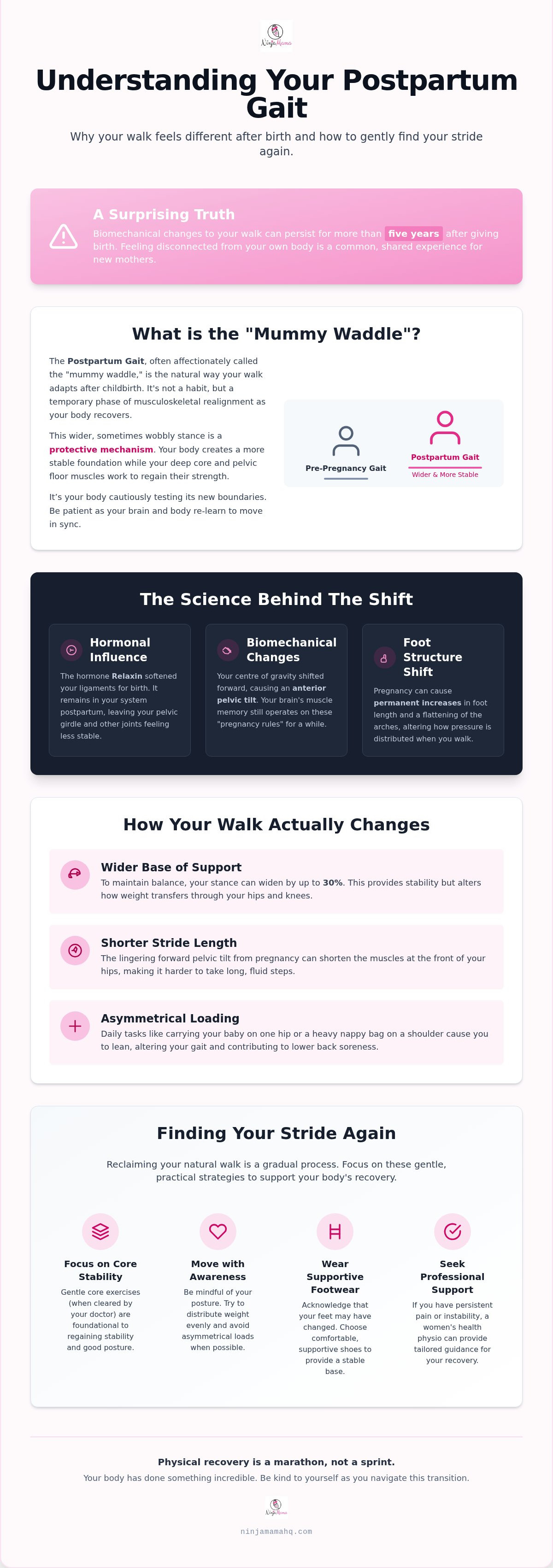
Did you know that biomechanical changes to your walk can actually persist for more than five years after you give birth? It is a bit of a shock, isn't it? If you feel like a stranger in your own body right now, please know that you aren't alone. You might notice that "pregnancy waddle" still sticking around while you are pushing the pram or simply moving around the house. This shift, known as The Postpartum Gait, is a completely natural adaptation your body made to keep you stable while carrying your precious bundle.
We understand how frustrating it feels when your hips ache or your lower back feels out of sync; it can be quite unsettling to feel so disconnected from your own movement. This article will help you understand why your stride has changed and, most importantly, how to gently support your body through this transition. We will look at the science behind the "mummy waddle," when you can expect to find your natural rhythm again, and practical ways to make every step feel a little more like you. From understanding pelvic stability to simple comfort measures, we are here to help you navigate your fourth trimester with confidence.
Key Takeaways
- Understand why your body maintains a wider stance after birth and why these biomechanical changes often persist well into the fourth trimester.
- Learn the science behind The Postpartum Gait and how your centre of gravity shifts as you transition from pregnancy to recovery.
- Discover the vital link between your walking style and pelvic floor health, including how to protect healing tissues from unnecessary strain.
- Gain practical, gentle strategies to help you reclaim your natural stride and improve your physical comfort while navigating daily life with a newborn.
- Find reassurance with realistic recovery timelines and learn when to seek professional support to ensure your long-term mobility and wellbeing.
What Exactly is the Postpartum Gait?
Have you ever caught your reflection in a shop window and wondered whose legs you were using? It is a common feeling. You have spent months adjusting to a growing bump, and suddenly, your body's architecture has shifted again. The Postpartum Gait isn't just a quirky habit you picked up during the third trimester; it is the way your walk evolves and adapts after childbirth as your skeleton and muscles begin the long journey of moving back into place. Many new mums expect to step out of the hospital with their pre-pregnancy stride, but the reality is often a little more "wobbly" than that.
The reason your walk doesn't snap back instantly is largely down to hormones, specifically Relaxin. This clever hormone softened your ligaments and joints to allow your baby to pass through the birth canal, but it doesn't simply vanish the moment you hold your little one. While your baby is safely in your arms, these hormones are still circulating, leaving your joints feeling a bit like jelly. These Physiological changes during pregnancy don't just reset overnight. It is completely normal to feel a deep emotional disconnect from your movement right now, as if your brain is sending signals that your legs aren't quite ready to follow yet.
The Residual Effects of Pregnancy Biomechanics
During the final months of pregnancy, your centre of gravity shifted significantly forward. To keep from toppling over, your body naturally tilted your pelvis and changed how your feet hit the ground. Your brain has spent months building "muscle memory" based on that heavy bump. Even though the weight has shifted, your nervous system is still playing by the old rules. Postpartum gait is a transitionary phase of musculoskeletal realignment. It is your body's way of cautiously testing its new boundaries while your core and pelvic floor muscles are still recovering their strength.
Why Australian Mums Call it the "Mummy Waddle"
If you feel like you are walking with a wider base of support, you aren't alone. Australian mums often affectionately call this the "mummy waddle," and for good reason. It describes that specific side-to-side motion that happens when your hips and pelvis feel slightly unstable. You might feel like "Bambi on ice" when you first head out for a walk with the pram. This wider stance is actually a protective mechanism; your body is trying to create a more stable foundation because your deep stabilising muscles aren't quite "online" yet. According to The State of Postpartum 2026, more women are now recognising that physical recovery is a marathon, not a sprint, and validating this "waddle" is the first step toward reclaiming your natural stride.
The Mechanics: Why Your Walk Feels Different
Your body has just performed an incredible feat of engineering. During pregnancy, your support base-the distance between your feet when you stand-can increase by up to 30% to help you stay upright. This wider stance doesn't simply narrow the moment you leave the delivery suite. The Postpartum Gait is defined by these lingering mechanical adjustments. You might find yourself still walking with your feet further apart, a habit your brain developed to manage a shifting centre of gravity. This wider base provides stability, but it also changes how your weight transfers through your hips and knees with every step.
Your stride length is also affected by the lingering anterior pelvic tilt from pregnancy. While you were carrying your baby, your pelvis likely tilted forward, which can shorten the muscles at the front of your hips and weaken the ones at the back. This tilt makes it harder to take long, fluid steps. When you add the physical demands of new motherhood, like carrying a seven-kilogram infant on one hip or lugging a heavy nappy bag over one shoulder, your posture continues to adapt. These asymmetrical loads can cause you to lean to one side, further altering your natural walk and potentially leading to that familiar soreness in your lower back.
Even your feet have changed. Research shows that pregnancy can lead to permanent increases in foot length and volume as the arches flatten under increased weight and hormonal influence. This change in foot shape alters how pressure is distributed across your soles. If your favourite pre-pregnancy shoes feel tight or "off," it is because your foundation has literally shifted. Prioritising physical comfort during these early weeks is essential for a smooth recovery, and many women find that wearing supportive postpartum disposable underwear helps them feel more "held together" and secure as they begin to move more frequently.
Pelvic Girdle and Hip Stability
Your sacroiliac (SI) joints, which connect your spine to your pelvis, underwent significant stress to "open" the birth canal. Post-birth, these joints can feel a bit loose or even "clicky" as they begin to tighten back up. This instability often makes your hips feel unreliable during your first few walks around the block. It is your body's way of telling you that the deep stabilising ligaments are still finding their strength after the massive expansion of labour.
Spatiotemporal Changes: Speed and Stride
You might notice you are walking much slower than usual. This isn't just fatigue; a systematic review of postpartum gait confirms that new mothers typically exhibit decreased gait speed and shorter stride lengths. This slower, more cautious gait is often the body’s way of protecting the pelvic floor from the high-impact forces of a regular walking pace. Your body is instinctively prioritising safety over speed while your core remains in its early recovery phase.
How Gait Affects Your Pelvic Floor Recovery
While we have explored the mechanical reasons your walk has changed, there is an even more important connection to consider: the relationship between your stride and your pelvic floor. Your pelvic floor doesn't work in isolation. It is the base of your core, and it reacts to every step you take. When you are navigating the early weeks of recovery, The Postpartum Gait can actually influence how quickly your internal tissues heal. A stable, balanced walk helps distribute pressure evenly, whereas an uneven or "guarded" gait can create unnecessary strain on a vulnerable area.
The Perineal Connection
If you are recovering from a vaginal birth, you might have stitches, grazing, or general swelling that makes movement feel a little daunting. It is a natural reaction to "favour" one side when you feel stinging or soreness. You might find yourself limping slightly or tilting your pelvis to avoid pressure on a specific spot. While this feels like you are protecting yourself, it can actually lead to "shearing" forces. These are lateral pulls on the pelvic floor muscles that can disrupt the healing of your perineum.
Managing this discomfort is the first step to finding your natural rhythm again. Reducing inflammation is key to moving with more confidence and symmetry. Many women find that using Ninja Mama Perineal Ice Packs helps to soothe that initial stinging and reduce the swelling that often hinders a comfortable walk. When you aren't constantly distracted by pain "down there," your body can relax into a more natural, even stride, which is much kinder to your healing tissues.
Core Stability and Pelvic Alignment
Think of your torso as a pressure canister. Your diaphragm is the lid, your abdominal muscles are the sides, and your pelvic floor is the base. For this system to work efficiently, everything needs to stay aligned. Many new mums fall into the habit of "tucking their tailbone" under as they walk, often as a way to feel more secure in their core. However, this posture can actually put more downward pressure on the pelvic floor and keep your glutes from firing properly.
Finding your postpartum walking balance is about more than just your feet; it is about how your whole body coordinates movement. If you feel like your walk is still "off" after the first few weeks, a visit to a Women’s Health Physio can be life-changing. They can perform a professional gait assessment to see if you are overcompensating in ways that might slow your recovery. Reclaiming your walk is a vital part of your physical healing, and it starts with giving your pelvic floor the stable foundation it deserves.
Finding Your Stride: Practical Tips for Recovery
Reclaiming your natural walk is a gradual process that requires patience and a bit of mindfulness. While you might be eager to get back to your pre-pregnancy fitness, The Postpartum Gait needs time to transition. Your body has spent nine months changing; it won't reset in nine days. The most important rule is to listen to your body and prioritise comfort over speed. If you feel pressure, heaviness, or pain, it is a signal to slow down and rest.
Before increasing your activity, your six-week check with a GP or obstetrician is essential. This is the perfect time to discuss any lingering "wobbliness" or pelvic pain. To help manage your energy, try to organise your day so that you aren't on your feet for hours at a time. Breaking your movement into smaller chunks is much kinder to your healing tissues than one long, exhausting trek. Even your footwear choice matters. Given the Australian climate, it is tempting to live in thongs, but your feet currently need the extra support of a well-fitted trainer to help stabilise your ankles and arches.
Gentle Movement and Awareness
Start with mindful walking. When you are moving around the house, try to visualise your pelvis as a level bowl of water. If you tilt too far forward or back, the water spills. This mental image helps you find a neutral pelvic position, which reduces the strain on your lower back. Another vital tip is the "exhale on exertion" rule. Whether you are lifting your baby, a capsule, or the groceries, remember to breathe out as you lift. This simple habit helps manage internal pressure and protects your pelvic floor from being pushed downwards.
Pram Ergonomics for New Mums
Your pram can either be a support or a hindrance to your recovery. Many mums accidentally distort their gait by slouching over the handles or pushing the pram too far ahead. Ensure your handle height is adjusted so your elbows are at a comfortable 90-degree angle. Keep the pram close to your body; this allows you to engage your core naturally and prevents the "leaning" that can aggravate hip pain. For a complete guide on managing these early weeks, you can explore The Ultimate Postpartum Self Care Kit, which covers the essentials for a smoother transition.
Investing in your physical comfort is an act of self-care that pays dividends for your long-term mobility. If you are looking for a curated way to support your body's healing, our Postpartum Recovery Kits offer the practical tools you need to feel more secure as you find your stride again.
Supporting the Fourth Trimester Journey
Recovery is often measured by clinical milestones, but we believe the true progress happens in the unspoken moments of your daily life. It is the first time you walk to the local park without checking for the nearest bench. It is the afternoon you realise you haven't thought about your hip alignment for hours. These small wins are the building blocks of your emotional confidence. When you feel physically capable, you feel more like yourself again. Reclaiming your movement after experiencing The Postpartum Gait isn't just about fitness; it is about rediscovering your independence and strength in this new season of life.
Physical comfort is the foundation of this confidence. If you are constantly managing discomfort or feeling "unstable" in your core, your mental energy is drained. By addressing the small, practical needs of your body, you clear the path for bigger milestones in mobility. Every gentle stroll and every mindful breath is an act of self-care. We want you to celebrate what your body has achieved rather than focusing on what it hasn't "snapped back" to yet. Your body is navigating a massive transition, and it deserves your grace and patience.
Recovery Essentials for the Active Mum
Staying mobile means feeling secure and dry, especially during those first few outings with the pram. Nothing disrupts your natural stride quite like bulky, uncomfortable protection. Many women find that using Ninja Mama Postpartum Disposable Underwear provides the secure, bulk-free support needed to walk with confidence. It allows you to move freely without the worry of leaks or shifting pads. Alongside the right gear, remember that your muscles need fuel to repair. Prioritising hydration and nutrient-dense meals is just as important as your physical exercises. Your ligaments and tissues are still recovering from the effects of The Postpartum Gait, and they need the right building blocks to regain their strength.
Community and Expert Support
There is a powerful sense of relief in knowing you aren't the only one navigating a "wobbly" walk. We encourage you to share your stories and even your "waddle" moments with your friends. Normalising these experiences reduces the anxiety that many women feel about their changing bodies. We are more than just a brand; we are a community of women who have "been there" and want to make your journey easier. You can read more about our heart and why we do what we do on our About Us page. Remember that your current walk is just a chapter, not the whole story. You’ve got this, mama.
Finding Your Forever Stride
Reclaiming your natural movement is a journey that deserves both time and the right tools. You now understand that The Postpartum Gait is a functional response to the incredible shifts your body underwent during pregnancy. By prioritising pelvic stability and using gentle ergonomics with your pram, you are already setting the stage for a stronger, more confident recovery. Physical comfort isn't a luxury; it is the foundation of your mobility and wellbeing.
We are here to support you through every "wobbly" step with empathy-led recovery solutions designed for the fourth trimester. Trusted by thousands of Aussie mums, our range is created by those who have "been there" to help you feel secure and supported. Find your recovery essentials in our curated Postpartum Bundles and take the next step in your healing journey with the care you deserve. You are doing an incredible job, mama.
Frequently Asked Questions
How long does the postpartum gait typically last?
While many women notice their stride improving within the first twelve weeks, biomechanical changes can actually persist for more than five years. It is a gradual process of musculoskeletal realignment rather than an overnight fix. Your body is working hard to regain core stability, and the "waddle" usually lessens as your pelvic floor and deep stabilising muscles recover their strength throughout the fourth trimester.
Is it normal for my hips to feel "loose" when I walk after birth?
Yes, it is completely normal for your hips to feel "clicky" or unstable due to the lingering effects of Relaxin. This hormone softened your ligaments for birth and takes several months to leave your system. This instability is a common feature of The Postpartum Gait, as your sacroiliac joints and pelvic girdle slowly return to their pre-pregnancy alignment and tension.
Can a postpartum gait cause lower back pain?
An altered walk often leads to lower back soreness because your muscles are overcompensating for a shifted centre of gravity. If your pelvis remains tilted forward, it puts significant strain on your lumbar spine with every step. Improving your walking pattern through mindful movement and supportive recovery gear can help reduce this discomfort and protect your spine as you find your rhythm.
What are the best shoes to wear for postpartum gait changes?
The best footwear for this transition is a supportive, well-fitted trainer that offers plenty of arch support. Since pregnancy can lead to permanent changes in foot length and volume, your old shoes may no longer provide the foundation you need. It is best to avoid flat thongs or high heels in the early months, as your feet and ankles require extra stability to manage your new walking pattern.
Should I see a physio for my "mummy waddle"?
You should consider seeing a Women's Health Physiotherapist if your walk feels painful or if you feel significantly unstable while moving. They can provide a professional gait assessment and tailored exercises to help you reclaim your natural stride. A physio is particularly helpful if you are experiencing pelvic girdle pain or feel that your walk is putting "shearing" force on your pelvic floor.
Can breastfeeding affect my walking gait due to hormones?
Breastfeeding can maintain higher levels of certain hormones in your body, which may keep your joints and ligaments feeling slightly looser for a longer period. This doesn't mean your walk won't improve, but it does mean you might need to be more patient with your recovery. The Postpartum Gait may feel more pronounced until your hormone levels eventually stabilise after you finish your breastfeeding journey.
How soon can I start walking for exercise after a C-section?
Most Australian health professionals recommend waiting until your six-week check before starting a formal walking program for exercise. While gentle movement around the house is encouraged early on, your core stability is significantly impacted by abdominal surgery. Start with very short, frequent bouts of walking to avoid straining your incision, and always listen to your body's signals for rest.
What happens if my gait doesn’t return to normal after six months?
If you still feel disconnected from your movement or experience persistent pain after six months, it is important to seek a professional evaluation. While some biomechanical changes are long-lasting, significant instability should be addressed by a specialist. A targeted rehabilitation plan focusing on core and glute strength can help you correct compensations and ensure your long-term mobility and physical confidence.

Article by
Louise Beever
Louise Beever is the founder of Ninja Mama, an Australian postpartum recovery brand focused on creating premium, practical recovery essentials for new mothers. Since launching Ninja Mama in 2018, Louise has worked closely with thousands of postpartum women and healthcare retailers to better understand the realities of recovery after birth. Her work focuses on postpartum preparation, recovery support, and improving awareness around the fourth trimester.
Remember Mamas
The information provided in this article is intended for general educational and informational purposes only and should not be considered medical advice. Always seek guidance from your doctor, midwife, lactation consultant, or qualified healthcare professional regarding your individual circumstances, pregnancy, birth, or postpartum recovery.