
You’re standing in the shower, finally enjoying two minutes of peace, when you look down and see it: a startling clump of hair circling the drain. Then you notice your brush is full, and there’s a trail of strands across your pillow. Is it normal to lose this much? It’s enough to make any new mum panic. You might feel like you’re losing your crowning glory just as you’re finding your feet in the fourth trimester. Understanding the Postpartum Hair Loss Timeline is the first step to realise that you aren’t actually going bald. Your body is simply exhaling after the hormonal marathon of pregnancy.
We know how overwhelming these physical changes feel when you’re already navigating sleepless nights and nappies. It’s completely normal to feel anxious about thinning patches or those tiny baby hairs around your forehead. This guide offers a reassuring, week-by-week look at telogen effluvium to help you breathe a sigh of relief. We’ll walk through exactly when the shedding starts, when it peaks, and how to manage your mane until your hair returns to its usual thickness. You’ve got this, and we’re here to help you feel like yourself again.
Key Takeaways
- Understand that shedding is a normal hormonal shift called telogen effluvium, where hair that stayed put during pregnancy finally starts to drop.
- Navigate the Postpartum Hair Loss Timeline with confidence, knowing that peak shedding usually occurs around the three to four-month mark.
- Adopt gentle hair care habits, such as using a wide-tooth comb and avoiding high-tension styles, to protect your hair while it is most fragile.
- Learn why maintaining adequate iron levels and nutritional support may help your body manage this transition more effectively.
- Recognise when to seek professional advice from your GP if shedding continues beyond twelve months or is accompanied by other physical symptoms.
Why is My Hair Falling Out? Understanding Telogen Effluvium
You probably noticed your hair looked incredible during pregnancy. It felt thicker, shinier, and somehow more resilient. This wasn't just a pregnancy glow fluke. High levels of oestrogen essentially hit the pause button on your hair's natural shedding cycle. Normally, about 10 to 15 per cent of your hair is in a resting phase at any given time. During pregnancy, those hormones keep your hair in the anagen or growth phase for much longer than usual. It's like your body decided to give you a temporary hair extension service for free.
Once your baby arrives, your internal chemistry shifts dramatically. This transition is the catalyst for the Postpartum Hair Loss Timeline many women find so distressing. This shift is a temporary condition. By Understanding Telogen Effluvium, you'll see that it occurs when a physical or hormonal stressor pushes a large number of hairs into the shedding phase all at once. It isn't a sign that anything is wrong; it's simply your body returning to its non-pregnant state.
The Role of Oestrogen and Progesterone
Think of oestrogen and progesterone as the glue that held your hair in place for nine months. Shortly after labour, these levels plummet. This hormonal crash signals to your hair follicles that it's time to move from the resting phase into the shedding phase. Your body is incredibly smart. In the weeks following birth, it prioritises vital organ recovery and healing your internal wounds over maintaining a thick head of hair. While it feels unfair, your system is just busy focusing its energy where it's needed most.
Dispelling the "Going Bald" Myth
It's vital to realise that you aren't actually losing new hair. You're just losing the hair you should have shed over the last nine months, all at once. Seeing 300 hairs in your brush every morning is a huge shock, but it doesn't mean you're headed for clinical alopecia. Unlike permanent hair loss conditions, this shedding is diffuse, meaning it happens all over the scalp rather than in specific, scaly patches. Supporting your vitality with targeted nutrition, such as Booby Booster, can help you feel more resilient as your body navigates this shedding peak. You aren't going bald; you're just catching up on nearly a year's worth of natural hair cycles in a few short months.
The Postpartum Hair Loss Timeline: A Month-by-Month Guide
Many new mums believe that by the time they reach their six-week postnatal check-up, the biggest physical transitions are behind them. However, the Postpartum Hair Loss Timeline usually operates on a slightly delayed schedule compared to other recovery milestones. Understanding this progression can help you feel more prepared when those first clumps appear in your hairbrush. It’s a process that follows a predictable path as your body recalibrates after baby.
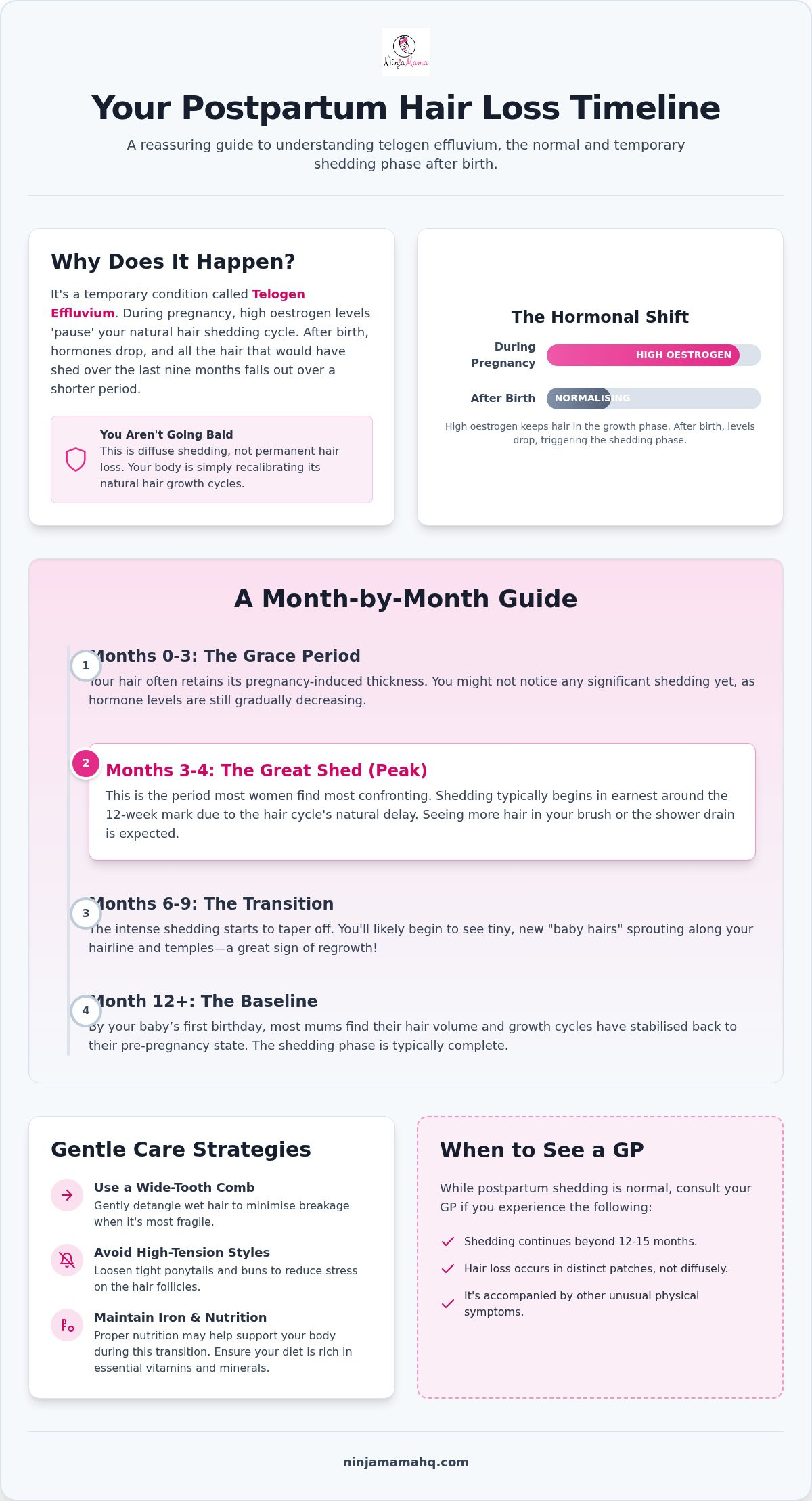
- Months 0-3: The Grace Period. During this initial phase, your hair often retains its pregnancy-induced thickness. You might even wonder if you’re one of the lucky few who will skip the shedding phase entirely.
- Months 3-4: The Great Shed. This is the period most women find most confronting. Shedding typically begins in earnest around the 12-week mark, often peaking quite suddenly.
- Months 6-9: The Transition. The intense shedding starts to taper off. While your hair might feel thinner than you’d like, you’ll likely begin to see tiny "baby hairs" sprouting along your forehead and temples.
- Months 12+: The Baseline. By your baby’s first birthday, most mums find their hair volume and growth cycles have finally stabilised back to their pre-pregnancy state.
Why Month Three is Often the Turning Point
It can feel cruel that hair loss hits just as you’re starting to navigate the peak of sleep deprivation and the end of the fourth trimester. There is a specific biological reason for this delay. The 90-day telogen cycle represents the biological gap between the hormonal trigger and the physical release of the hair strand, explaining why shedding waits until the three-month mark to begin. Knowing What to Expect with Postpartum Hair Loss helps remove the element of surprise during an already exhausting time. As your body works hard to restore its balance, sipping on a warm cup of Booby Booster lactation tea can be a lovely way to nourish yourself while you wait for your hormones to settle.
Recognising the Signs of New Growth
The first sign that your hair is returning to its normal rhythm is often the appearance of a "halo" of short, flyaway hairs. You’ll notice these most prominently at your temples or along your part line. While they can be frustrating to style, these tufts are a cause for celebration. You can distinguish between healthy new growth and breakage by looking at the ends of the hair; new sprouts have a fine, tapered point, whereas broken hairs look blunt or frayed. These tiny "sprouts" are proof that your follicles are active and healthy. It’s a sign that your body has successfully navigated the most intense part of the Postpartum Hair Loss Timeline and is now focused on renewal.
Gentle Hair Care Strategies for the Shedding Phase
When you’re in the thick of the Postpartum Hair Loss Timeline, seeing strands on your clothes and floors can feel like a constant reminder of the changes your body is navigating. While you can't stop the biological process of shedding, you can certainly change how you treat your hair to minimise extra loss. Follicles are particularly sensitive during this phase, so being extra gentle is the best way to protect the hair you have while waiting for new growth to appear.
One of the most important shifts you can make is avoiding high-tension hairstyles. The classic, tight "mum bun" is a lifesaver when you’re busy with a newborn, but that constant pulling can put immense strain on your hairline. Instead, try loose braids or low, soft ponytails. Switch your standard hairbrush for a wide-tooth comb, especially when your hair is wet. Hair is at its most fragile when it’s soaking, so detangling with care prevents unnecessary breakage.
Your product choice matters too. Swapping out heavy, moisture-rich conditioners for lightweight, volumising shampoos can give your hair a much-needed lift. Heavy products often weigh down fine strands, making any thinning more obvious. If the shedding feels particularly overwhelming, you might consider the "postpartum chop." A shorter, layered haircut removes the weight that drags on your roots and can make your hair look significantly fuller and healthier.
Washing and Styling with Care
Reducing the frequency of heat styling is a simple way to keep your strands resilient. Blow-drying and straightening can strip moisture and weaken the hair shaft, so try air-drying whenever your schedule allows. Many mums find that swapping a cotton pillowcase for a silk or satin version helps reduce friction during the night, preventing those stubborn morning tangles. When you do need to tie your hair back, always reach for soft fabric scrunchies rather than traditional elastic ties that can "bite" into and snap fragile hair.
The Ninja Mama Approach to Self-Care
Managing postpartum hair loss is about more than just vanity; it’s an essential part of your recovery journey. Integrating these gentle habits into your postpartum self care kit can help you feel more like yourself during a time of huge transition. We know that feeling good about your appearance can provide a vital boost to your emotional wellbeing. It’s okay to feel frustrated by the "messy" parts of recovery. By accepting these changes with grace and focusing on small acts of care, you’re supporting your overall vitality as you move through the fourth trimester.
Supporting Your Body from Within: Nutrition and Vitality
Your hair is a direct reflection of what's happening deep inside your system. While we often focus on shampoos and serums, the most effective way to navigate the Postpartum Hair Loss Timeline is by nourishing your body from the roots up. Postpartum depletion is a very real challenge; your body has just performed the ultimate marathon and is now working overtime to recover while potentially producing milk for your little one. This double demand on your resources can leave your follicles feeling a bit neglected.
Iron levels, specifically ferritin, play a massive role in hair retention. It's incredibly common for Aussie mums to have low iron stores following labour, which can unfortunately signal your follicles to stay in that shedding phase for longer than necessary. Alongside iron, your hair relies on a steady supply of Biotin, Zinc, and Vitamin C to build strong keratin structures. If you're breastfeeding, your body will naturally prioritise milk production over "non-essential" tasks like growing hair. This means you need extra calories and targeted nutrients to ensure there's enough left over for your own physical vitality.
Stress also plays a sneaky role in how your hair behaves. High cortisol levels can actually exacerbate the intensity of the shed. Finding small ways to lower your stress, even just five minutes of prepared calm, can help your body shift back into a growth rhythm sooner. When your nervous system feels safe and nourished, your hair is much more likely to follow suit.
Lactation-Safe Nutrition for Hair Support
We know that sitting down for a gourmet, nutrient-dense meal is nearly impossible with a newborn in your arms. This is where smart, easy swaps become your best friend. Incorporating a nutrient-dense organic lactation chocolate drink into your daily routine is a delicious way to support your overall energy. Ingredients like flaxseed and brewer's yeast provide essential B vitamins and healthy fats that your hair craves. Don't forget the simplest tool in your kit: hydration. Keeping your water intake high ensures that those vital nutrients actually reach your follicles through your bloodstream.
The Impact of Postpartum Depletion
Your body is a master prioritiser. During the fourth trimester, it will always put your baby's needs and your internal healing first. This is why many Aussie GPs recommend continuing your postnatal vitamins well into the first year. Addressing depletion isn't just about your hair; it's about your energy, mood, and long-term wellbeing. If you're looking for a simple way to boost your daily nutrient intake, you can shop our Booby Booster range to help support your body through this demanding transition. Taking care of yourself is the best gift you can give your baby and your recovery.
When to See a GP: Distinguishing Normal Shedding from Other Issues
While the Postpartum Hair Loss Timeline usually resolves itself by your baby's first birthday, it's important to know when the "Great Shed" might be hiding something else. Most of the time, that clump in the drain is just a sign of your hormones recalibrating. However, there are specific red flags that suggest your body might need a little extra support from a medical professional. Distinguishing between a normal hormonal shift and a underlying condition ensures you get the care you deserve during this vulnerable transition.
If you find that your shedding continues at a high rate beyond the 12-month mark, it’s worth booking an appointment with your GP. By this stage, most women should see their growth cycles returning to a pre-pregnancy baseline. You should also take note of how your scalp feels. Normal postpartum shedding shouldn't be painful. If your scalp feels itchy, inflamed, or tender to the touch, this could indicate a skin condition rather than a hormonal hair cycle. Additionally, keep an eye on the pattern of loss. While telogen effluvium causes general thinning all over the head, distinct, smooth bald patches could point toward other types of hair loss that require specific treatment.
Postpartum Thyroiditis and Anaemia
Many Aussie mums fall into the trap of mistaking serious medical symptoms for "just being a tired new parent." It’s a common story. Postpartum thyroiditis and anaemia can both cause significant hair loss, and they often go hand-in-hand with extreme fatigue, cold intolerance, or sudden skin changes. A simple blood test is the best way to check your iron stores and hormone levels. Your GP can look at your ferritin levels to see if you’re actually depleted. Getting these levels back on track can often slow down the shedding and give your energy a much-needed boost.
Trusting Your Instincts, Mama
You know your body better than anyone else. If you feel that something isn’t quite right, don't be afraid to advocate for your health and seek a second opinion. At Ninja Mama, we are more than just a brand; we are a community of women who have "been there" and understand the highs and lows of the fourth trimester. You can learn more about us and our mission to support your wellbeing through every stage of motherhood. Remember that the Postpartum Hair Loss Timeline is just one small part of your journey. This phase will pass, your "crowning glory" will return, and you are doing a brilliant job navigating it all.
Embracing Your Postpartum Renewal
Navigating the Postpartum Hair Loss Timeline can feel like an emotional rollercoaster, but remember that this phase is a temporary part of your body’s incredible recovery journey. By understanding the biological shifts behind the shed and supporting your system with gentle care and targeted nutrition, you can wait out the peak with confidence. Those tiny baby hairs are a sign of renewal; they prove that your body is already working hard to restore itself. It's a season of transition that eventually leads back to your usual crowning glory.
As an Australian-owned small business, Ninja Mama is here to support you through every messy, beautiful moment of the fourth trimester. Our midwife-approved recovery essentials are designed to provide the comfort and confidence you deserve while you find your feet as a new mum. Whether you need nutritional support or physical relief, we’ve got your back with products designed by a mum who has been exactly where you are now.
Shop the Ninja Mama Recovery Range for a Softer Fourth Trimester and take a proactive step toward your own wellbeing. You’re doing a brilliant job, Mama, and this season of change is just the beginning of your growth.
Frequently Asked Questions
How long does postpartum hair loss last on average?
Most Aussie mums find the shedding phase lasts roughly six to nine months in total. It typically kicks off around three months after birth, peaks at the four-month mark, and begins to taper off as you approach your baby’s first birthday. While the peak shedding period feels intense, your follicles are usually back to their regular growth rhythm within a year.
Can I prevent postpartum hair loss from happening?
You can't actually prevent this process because it is a biological response to shifting hormone levels. Since your hair stayed in the growth phase longer than usual during pregnancy, your body must eventually release those extra strands. Navigating the Postpartum Hair Loss Timeline is about management and gentle care rather than trying to stop a natural hormonal reset.
Is postpartum hair loss worse if I am breastfeeding?
There is no clinical evidence that breastfeeding makes the shedding more severe, but it does increase your body's nutritional demands. If you aren't consuming enough calories or essential minerals, your system may prioritise milk production over hair retention. Staying nourished with healthy snacks and consistent hydration helps support your overall vitality while your hormones recalibrate.
Will my hair ever be as thick as it was during pregnancy?
Your hair will likely return to its pre-pregnancy thickness, but it won't stay as lush as it was during those nine months. Pregnancy hair is essentially "extra" hair that stayed on your head past its used-by date due to high oestrogen. Once your hormones stabilise, your volume should settle back to your usual, beautiful baseline.
Are there any specific vitamins that stop hair shedding after birth?
There isn't a magic vitamin that can stop the shed entirely, but certain nutrients support the regrowth process. Iron, biotin, and zinc are commonly used by postpartum mothers to support hair health and follicle strength. Aussie GPs often recommend continuing your postnatal vitamins for at least six months to ensure your body has the building blocks it needs.
Is it normal to have bald spots near my temples after having a baby?
It is very common to notice significant thinning or "see-through" patches around the temples and hairline. This area is often the most visible part of the Postpartum Hair Loss Timeline. While it looks startling in the mirror, these are usually the first spots where you’ll eventually see those fuzzy, short baby hairs start to sprout back.
Does stress make postpartum hair loss worse?
High stress levels can unfortunately prolong the shedding phase or make it feel more intense. Cortisol, the stress hormone, can signal even more follicles to enter the resting phase prematurely. Finding small moments for self-care and prioritising rest whenever your baby allows can help your body stay in a healthy, calm recovery mode.
Should I cut my hair short to hide the thinning?
Many women find that a "postpartum chop" makes thinning much less noticeable and easier to manage. Shorter styles remove the excess weight that pulls on fragile roots, giving your hair a fuller, more voluminous appearance. It’s also a practical way to deal with the "hair everywhere" phase while making your morning styling routine much faster.

Article by
Louise Beever
Louise Beever is the founder of Ninja Mama, an Australian postpartum recovery brand focused on creating premium, practical recovery essentials for new mothers. Since launching Ninja Mama in 2018, Louise has worked closely with thousands of postpartum women and healthcare retailers to better understand the realities of recovery after birth. Her work focuses on postpartum preparation, recovery support, and improving awareness around the fourth trimester.
Remember Mamas
The information provided in this article is intended for general educational and informational purposes only and should not be considered medical advice. Always seek guidance from your doctor, midwife, lactation consultant, or qualified healthcare professional regarding your individual circumstances, pregnancy, birth, or postpartum recovery.