
What if that stubborn overhang above your scar isn't actually about your fitness level or how many core exercises you've done since bub arrived? With the C-section rate reaching 32.5% in 2025, more women than ever are asking about the c-section shelf what causes it and why their body feels so different. It's completely normal to feel a bit disconnected from your "new" shape, especially when you're also navigating physical numbness or the frustration of clothes that pinch in all the wrong places.
We understand that this transition can feel overwhelming, but we want to reassure you that your body is doing an incredible job of healing. This "shelf" is a structural result of how your tissues knit back together across multiple layers, rather than a matter of "mum tum" fat. In this article, we'll help you understand the biological reasons behind the overhang and share gentle, effective ways to care for your scar. You'll discover practical, non-surgical steps to improve how your body feels and learn how to support your recovery with the kindness and patience you deserve.
Key Takeaways
- Understand the structural reality of the overhang and learn about the c-section shelf what causes it during the body's complex, multi-layered healing journey.
- Discover why traditional abdominal exercises like crunches can often do more harm than good and why the "shelf" is not a reflection of your fitness or effort.
- Learn gentle, practical techniques like scar massage and the use of silicone scar strips that may help support tissue flexibility and improve scar appearance.
- Identify ways to keep your incision site hydrated and protected from irritation to ensure your daily movements feel more comfortable and supported.
- Embrace a patient, "slow and steady" mindset for your fourth trimester, remembering that every mother’s recovery is unique and healing is never a linear process.
What is a C-Section Shelf? Understanding the "Pouch"
Many Australian mums find themselves looking in the mirror and wondering about the new fold of skin resting just above their scar. This "pouch" or overhang is what's commonly known as a C-section shelf. It's a very normal part of the recovery journey for thousands of women who have a Caesarean section. You might notice it right away, or it could become more obvious months later as your postpartum swelling goes down. If you're feeling a bit frustrated or confused about the c-section shelf what causes it, please know you aren't alone and your body is doing its best to heal.
To help you visualise what's happening beneath the surface, watch this helpful video:
While a shelf is generally a cosmetic or structural concern, it's different from an incisional hernia. A hernia happens when internal tissue pushes through a weakened spot in the abdominal wall. If you notice a hard lump, sharp pain when you cough, or a bulge that changes when you lie down, it's best to chat with your doctor or women's health physio. Most of the time, that "shelf" is simply a sign of how your body has knit itself back together after the incredible feat of bringing life into the world.
The Visual Reality of Post-Caesarean Healing
The shelf often looks like a distinct "step" where the skin above the scar drapes over the incision line. It's often accompanied by strange sensations like numbness, tingling, or even a "pins and needles" feeling. These sensations occur because the nerves in the area were interrupted during the procedure. It can be emotionally tough to see your abdominal contour change so significantly. Feeling disconnected from your "new" body is a valid response, and it's okay to take your time as you get to know this version of yourself. Your body has been through a major surgical event, and the way it looks now is a testament to its strength.
Shelf vs. Mum Tum: What is the Difference?
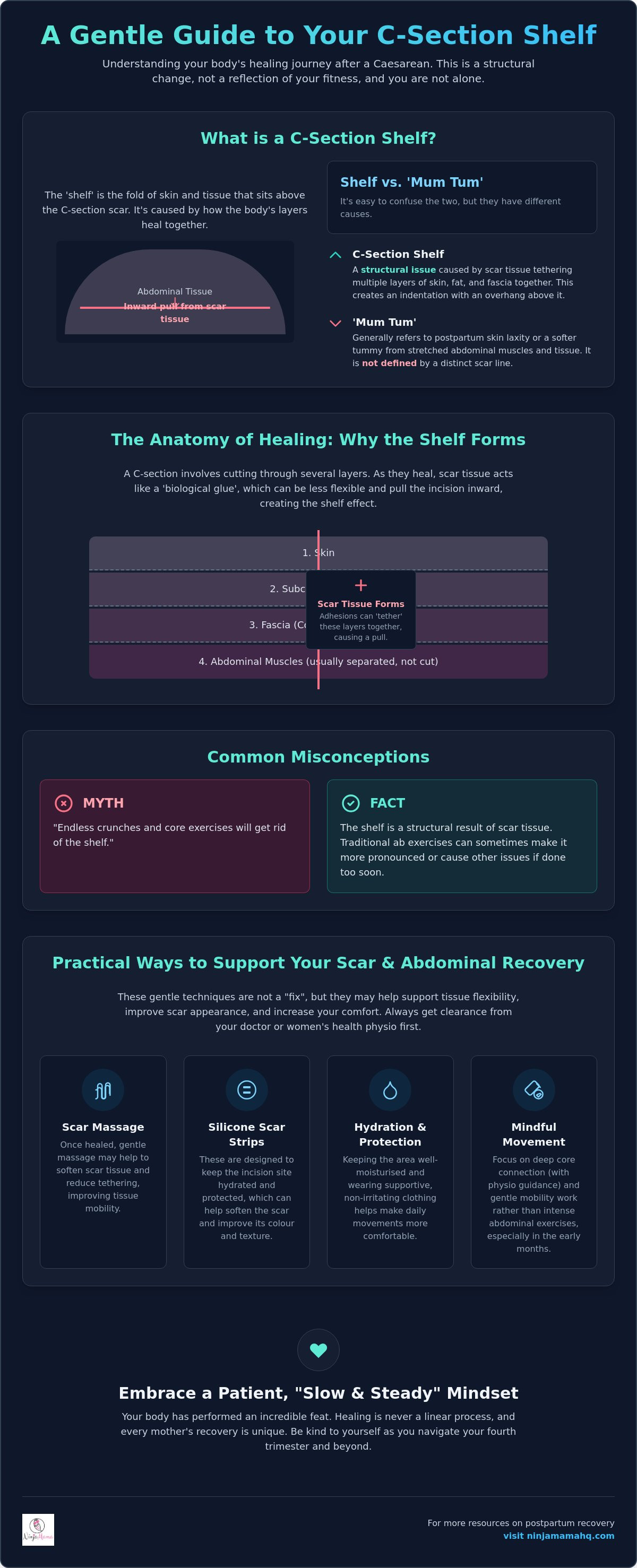
It's quite common for people to confuse the shelf with a "mum tum," but they are actually quite different. A mum tum usually refers to general skin laxity or a bit of extra cushion after pregnancy. The shelf, however, is structural. It's primarily caused by scar tethering, where the internal scar tissue acts like a tight drawstring. This "biological glue" pulls the incision line inward while the skin and tissue above it stay in place, creating that bulging effect. This is why weight loss alone rarely "removes" a true C-section shelf. You can't simply exercise away a structural scar connection, and understanding this can take a huge weight off your shoulders. It isn't about your fitness level; it's about how your tissues have healed together.
The Anatomy of Healing: What Causes the C-Section Shelf?
A Caesarean is a major surgical event that involves more than just a simple incision through the skin. To safely deliver your baby, your obstetrician carefully moves through several distinct layers of your abdominal wall. These include the skin, the subcutaneous fat, the fascia (the tough connective tissue covering your muscles), and the muscles themselves. While recovering from a C-section, your body relies on scar tissue to mend these layers. This tissue acts as a biological glue, but because it is less flexible than the original tissue, it can sometimes create a firm, fixed line where the incision was made.
When we explore the c-section shelf what causes it, we see that the skin above the scar has often been stretched significantly during pregnancy. Once the baby is born, that extra skin doesn't always bounce back immediately. When this slightly looser skin meets the firm, immobile line of the scar, it naturally drapes over the top. It's a bit like a wave breaking over a sea wall; the structure underneath dictates how the surface appears. Many women find that keeping the area hydrated and supported with silicone scar patches can help the tissue feel more supple during this phase.
Scar Tethering and Adhesions
Adhesions are bands of internal scar tissue that can cause tissues or organs to stick together. In the case of a C-section, the scar can sometimes "tether" or stick to the underlying fascia or muscle rather than gliding smoothly over them. This creates a deep anchor point that pulls the skin inward. The scar acts like a drawstring on a pouch, pulling the tissue tight at the base and causing the looser skin above to bulge outward.
Abdominal Muscle Separation (Diastasis Recti)
Many mums also experience Diastasis Recti, where the "six-pack" muscles stay separated after pregnancy. When these muscles aren't providing a strong foundation for your abdominal wall, the internal pressure can push outward more easily. This lack of support works in synergy with scar tethering to make the shelf look more prominent. If you're concerned about muscle separation, a quick check-in with a women’s health physio is a wonderful way to get a tailored plan for your core health.
The Role of Lymphatic Drainage and Swelling
The horizontal incision used in most modern births can temporarily disrupt the natural upward flow of lymphatic fluid in your lower belly. This often leads to "post-op puffiness" or localized swelling just above the scar line. You might notice that your shelf looks more pronounced after a busy day on your feet or when you've been particularly active. This fluctuation is a normal part of the inflammatory process as your body continues to repair itself in the months following birth.
Common Misconceptions: Why Crunches Won’t "Fix" the Shelf
It’s one of the most persistent myths in the postpartum community: the idea that a C-section shelf is simply "stubborn fat" or a sign that you haven't spent enough time on the gym floor. This couldn't be further from the truth. Because we’ve already explored the c-section shelf what causes it, we know the issue is primarily structural and related to how your internal tissues have healed. Thinking you can simply crunch your way out of a shelf is like trying to loosen a fixed anchor by pulling harder on the rope; it doesn't address the underlying tension that is holding everything in place.
Traditional abdominal exercises, particularly high-intensity crunches or leg lifts, can actually be counterproductive during your early recovery. These movements create significant intra-abdominal pressure that pushes outward against your abdominal wall and down onto your scar site. When we look at the c-section shelf what causes it, we see that the tension is often deeper than the skin level, which is why superficial exercises often miss the mark. In some cases, significant weight loss can actually make the shelf more prominent. When the underlying fat layer decreases, the skin has less "fill," which can cause it to drape even more noticeably over the tethered scar line.
Instead of trying to "fix" or "erase" the shelf, we encourage you to reframe your goal toward supporting and softening the tissue. This shift in mindset allows you to treat your body with the kindness it deserves while working on functional recovery that actually feels good. It’s about restoration, not just perspiration.
Why Tension Matters More Than Strength
A restricted, tight scar needs mobility far more than it needs raw muscle strength. If you focus only on "bracing" your core without addressing the internal adhesions we discussed earlier, you might actually be increasing the downward pressure on your pelvic floor and scar. Functional movement, like gentle pelvic tilts or diaphragmatic breathing, helps to slowly introduce flexibility back into the area. It’s about teaching your tissues to glide again, rather than just forcing them to be strong.
The Impact of Posture on the C-Section Pouch
Many new mums develop what is often called the "C-section slouch." It’s a natural, protective instinct to hunch forward to shield your incision from pain or irritation. However, staying in this rounded position for long periods shortens the muscles in your front body and encourages the abdominal wall to settle into a folded position, making the shelf look more pronounced. Simply opening up your chest and gently stretching your hips can help your abdominal wall settle into a more neutral, elongated position. Once your GP or midwife has given you the all-clear, these gentle movements can make a world of difference.
Practical Ways to Support Your Scar and Abdominal Recovery
While understanding the c-section shelf what causes it is the first step toward feeling more like yourself, the second step is taking practical, daily action to nurture your recovery. Many mums feel left in the dark after their six-week check, but your scar care journey is only just beginning. By focusing on hydration, protection, and gentle movement, you can support your body as it continues to remodel that internal "biological glue" we discussed earlier. It is about creating the best possible environment for your tissues to heal with flexibility rather than restriction.
The Power of Silicone Scar Patches
Silicone therapy is widely considered the gold-standard for non-surgical scar management. It works by creating a protective "micro-climate" over the incision, which helps to lock in moisture and regulate collagen production. Using C-section silicone scar patches can help to soften and flatten the scar line over time. For the best results, consistency is your best friend. Most specialists recommend wearing them for at least 12 weeks to give the tissue ample time to respond and settle. This simple barrier also protects your sensitive scar from the friction of clothing, which can reduce that annoying tingly or itchy sensation.
Choosing the Right Postpartum Underwear
In those early weeks, the last thing you want is a waistband digging into your sensitive incision. Choosing high-waisted underwear that sits well above the scar line is essential for both comfort and hygiene. Ninja Mama postpartum disposable underwear provides a soft, breathable barrier that won't catch on staples or stitches. The light compression offered by quality postpartum undies can also provide a sense of "held-in" security, supporting your abdominal wall as you start moving more freely. This gentle support helps manage the post-op puffiness that often makes the shelf look more prominent.
Scar Massage: A Gentle How-To
Once your scar is fully closed and you've received the all-clear from your GP or midwife, you can begin gentle scar massage. This isn't about deep, painful pressure; it's about restoring glide to the tissues. Start with simple desensitisation by lightly stroking different textures, like a soft cotton ball or silk scarf, over the area. When you're ready for manual massage, try the "clock method" to encourage mobility:
- Place your fingers on the skin near the scar, rather than directly on the incision itself.
- Gently move the skin toward 12 o'clock, then down to 6, and across to 3 and 9.
- Notice any directions that feel "stuck" or resistant.
- Spend a little extra time gently encouraging movement in those restricted directions.
Ready to build your ultimate recovery toolkit? Explore our curated Postpartum Recovery Bundles to find everything you need for a more comfortable fourth trimester.
Navigating the Fourth Trimester with Confidence
The fourth trimester is a season of profound change, and your body deserves a slow, steady approach to recovery. By now, you have a clearer picture of the c-section shelf what causes it, but understanding the biology is just one part of the puzzle. Healing isn't a race; it's a non-linear journey that looks different for every mother. Some days you might feel strong and capable, while others might bring a sense of frustration as you look in the mirror. Both experiences are completely valid. At Ninja Mama, we are here to walk beside you, providing the tools and reassurance you need to feel comfortable in your skin again.
Remember that your "shelf" is a unique part of your story. Whether it settles significantly or remains as a soft reminder of your baby's birth, it doesn't define your health or your worth. Your body has performed a miracle, and the way it has knit itself back together is a testament to its resilience. Give yourself permission to rest and focus on restoration rather than "bouncing back."
When to See a Women’s Health Physiotherapist
While home care is wonderful, seeking professional guidance can be a game-changer for your physical and emotional wellbeing. We recommend booking an 8-week check-up with a women’s health physiotherapist specifically to assess your abdominal wall and scar health. They can perform internal scar release techniques to help loosen those deep adhesions we discussed earlier. You should definitely reach out if you experience any of these red flags:
- Persistent pain or a sharp "pulling" sensation at the scar site.
- Significant leaking or pelvic floor heaviness when you move.
- A bulge that feels hard, painful, or increases when you cough.
- Redness, heat, or unusual discharge around the incision.
Self-Care Beyond the Scar
Recovery is about more than just the incision site. Your skin’s elasticity and your body’s ability to repair tissue rely heavily on proper nutrition and consistent hydration. Focusing on collagen-rich foods and staying hydrated helps support the remodeling of your scar tissue from the inside out. Taking a moment for yourself can also do wonders for your spirit. Many mums find that a warm cup of Booby Booster lactation tea provides a much-needed ritual of calm during those busy postpartum days.
Be kind to yourself as you navigate this new chapter. Your body has changed, yes, but it has also grown, protected, and delivered life. That is something to be celebrated every single day. If you're ready to invest in your comfort and support your healing journey, Explore our full C-Section Recovery range here.
Embrace Your Recovery Journey with Confidence
Understanding the c-section shelf what causes it is the first step toward feeling more like yourself in your postpartum body. It isn't about stubborn fat or a lack of core strength; it's about the incredible way your body has mended itself through complex layers of tissue and biological glue. By focusing on gentle scar massage, staying hydrated, and protecting your incision with premium high-waisted support, you can encourage flexibility and comfort during your fourth trimester. Remember that healing is a deeply personal, non-linear process that deserves your patience and kindness.
As an Australian owned and operated brand, Ninja Mama is here to support you with evidence-aware recovery solutions that prioritise your wellbeing. We believe that practical care should also feel beautiful, which is why our range is designed by mums who have been exactly where you are now. Ready to nurture your healing? Shop the Ninja Mama C-Section Recovery Essentials today. You've done something extraordinary, and your body is a testament to that strength. Be gentle with yourself, Mama.
Frequently Asked Questions
Will my C-section shelf ever go away completely?
Whether a shelf disappears entirely depends on your individual healing process and the level of internal tethering. Many women find that the overhang softens and becomes significantly less noticeable with consistent scar care and core rehabilitation. While the structural anchor of the scar might remain, focusing on tissue mobility can help the area settle into a much smoother contour. Every body is unique, so your results will be personal to your journey.
How soon after a C-section can I start treating the shelf?
You can typically begin gentle external care once your incision is fully closed and your healthcare provider gives you the all-clear, which is usually around the six-week mark. This is a great time to start using silicone strips or applying hydrating oils to the area. Deep tissue work or intensive scar massage should wait until your internal layers have had more time to heal. Always listen to your body and prioritise comfort over speed.
Is the C-section shelf caused by fat or skin?
The shelf is actually a combination of skin laxity, internal scar tissue, and how your fascia has mended. When we explore the c-section shelf what causes it, we see that the scar acts like a tight, immobile drawstring. The skin and tissue above this point are more flexible and naturally drape over the firm anchor line. It is not simply a matter of body fat, which is why weight loss alone rarely resolves a true structural shelf.
Can I get rid of the C-section pouch without surgery?
Many mothers achieve wonderful results using non-surgical methods like scar massage, silicone therapy, and pelvic floor physiotherapy. these practices help to break up internal adhesions and restore flexibility to the abdominal wall. While these tools might not "erase" the shelf for everyone, they can significantly improve how the area looks and feels. Consistency with gentle, supportive care is the key to seeing real change in your tissue's texture and appearance.
Does wearing a binder help with the C-section shelf?
Wearing a binder or light compression underwear provides excellent support and a sense of security during your early recovery weeks. It may help manage post-operative swelling, which often makes the shelf look more pronounced in the beginning. However, a binder is a temporary support tool rather than a permanent fix. It won't remove the internal scar tethering, but it certainly makes moving around much more comfortable while your body heals.
Why is my C-section scar shelf numb even years later?
Lingering numbness is very common because the nerves in your abdominal wall were interrupted during the surgery. These nerves heal quite slowly, and for some women, the sensation never fully returns to exactly how it was before. You might feel "pins and needles" or a strange tingly sensation when the area is touched. Gentle desensitisation techniques, like stroking the area with different fabrics, may help support nerve recovery over time.
Can scar massage really help with the overhang?
Scar massage is one of the most effective ways to improve the mobility of your scar and the surrounding tissue. By gently encouraging the layers of skin and fascia to move independently again, you can reduce the tight "pulling" that creates the shelf effect. Many women find that regular massage makes the area feel softer and less restricted. It is a simple yet powerful way to reconnect with your body and support your long-term recovery.
Does the type of incision (horizontal vs. vertical) affect the shelf?
Most modern births use a horizontal "bikini" incision, which is more likely to create a shelf because it cuts across the natural lymphatic flow. This is the experience for the majority of the 32.5% of mothers who had a Caesarean in 2025. When investigating the c-section shelf what causes it, we find that vertical incisions heal with a different tension pattern and rarely result in the same draping effect, though they are much less common today.

Article by
Louise Beever
Louise Beever is the founder of Ninja Mama, an Australian postpartum recovery brand focused on creating premium, practical recovery essentials for new mums. Since launching Ninja Mama in 2018, Louise has worked closely with thousands of postpartum women and healthcare retailers to better understand the realities of recovery after birth. Her work focuses on postpartum preparation, recovery support, and improving awareness around the fourth trimester.
Remember, Mums
The information provided in this article is intended for general educational and informational purposes only and should not be considered medical advice. Always seek guidance from your doctor, midwife, lactation consultant, or qualified healthcare professional regarding your individual circumstances, pregnancy, birth, or postpartum recovery.