

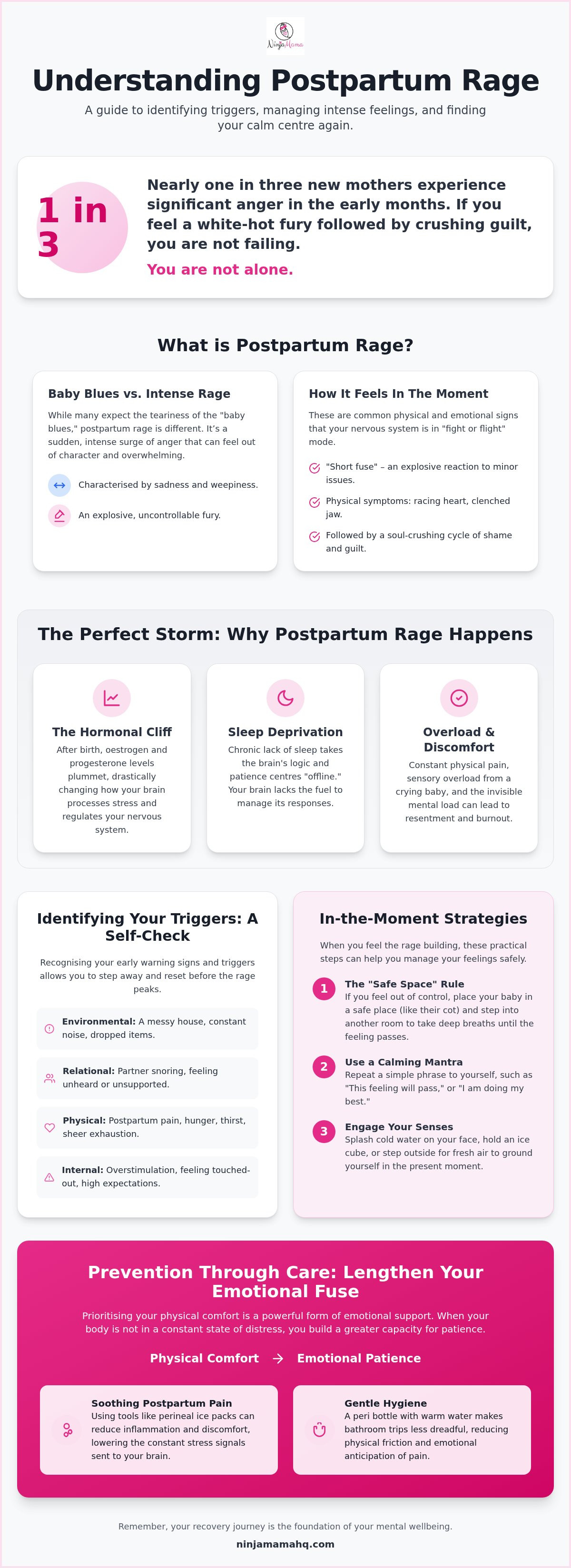
Did you know that nearly one in three new mothers experience significant anger during the early months of parenthood? You might find yourself shaking with a white-hot fury because the baby won't settle or your partner is snoring, only to be hit by a crushing wave of guilt moments later. It’s a terrifying feeling that leaves you wondering if you’re failing at this whole motherhood thing. Please hear this: you aren't a bad person, and you certainly aren't alone.
We understand that Postpartum Rage is a real, physiological response to the "perfect storm" of sleep deprivation, hormonal shifts, and physical healing. It’s often your body’s way of signalling that it is completely overwhelmed. In this article, we will help you identify your specific triggers and discover how prioritising your physical comfort can actually help lengthen your emotional fuse. You’ll find practical, gentle tools to manage these intense feelings and learn why your recovery journey is the foundation of your mental wellbeing. Let’s look at how you can move from feeling out of control to finding your calm centre again.
Key Takeaways
- Understand the difference between the "baby blues" and the intense, sudden surges of Postpartum Rage to help validate and normalise your experience.
- Learn how the "hormonal cliff" and chronic sleep deprivation create a physiological response that directly impacts your ability to regulate emotions.
- Discover how to identify your unique early warning signs and environmental triggers before they peak, allowing you to step away and reset.
- Master practical, in-the-moment strategies like the "Safe Space" rule to manage your feelings while keeping yourself and your baby safe.
- Explore how prioritising physical comfort and recovery can serve as a vital foundation for your emotional patience and overall mental health.
What is Postpartum Rage? Breaking the Silence on 'Mum Rage'
Postpartum rage is a common but under-discussed mood disruption that often hits in the fourth trimester. While most of us are prepared for the "baby blues", those teary first few weeks where everything feels a bit much, nobody really warns us about the white-hot fury that can bubble up out of nowhere. It is an intense, often sudden surge of anger that feels completely out of character. If you’ve found yourself screaming at a cupboard that won't close or feeling an irrational level of irritation at your partner's breathing, please know this: you aren't a "bad mum". You are a person navigating a massive physiological shift, and you are definitely not alone in this experience.
How Postpartum Rage Feels in the Real World
In the real world, Postpartum Rage doesn't usually look like a calculated argument. It's more like a "short fuse" syndrome where a minor inconvenience, like a dropped spoon or a laundry basket that's too full, triggers an explosive reaction. You might feel your heart racing, your jaw clenching, or a literal "red mist" descending over your vision. When your body is in pain or you're dealing with the discomfort of healing, your patience is naturally thinner. This is why addressing physical recovery with tools like perineal ice packs can actually be a form of emotional support; when you feel physically better, you're less likely to reach that breaking point.
Once the moment passes, it’s almost always followed by a heavy, soul-crushing cycle of shame. That "mum guilt" can be overwhelming, making you feel like you've failed, but these physical sensations are often just your nervous system being stuck in "fight or flight" mode. Understanding that your body is simply overstimulated is the first step toward self-compassion.
Rage vs. Postnatal Depression: What's the Connection?
It's helpful to understand that rage isn't always a standalone issue. It can be a "noisy" symptom of Postpartum depression or anxiety. While we often associate PND with persistent sadness or withdrawal, for many women, that internal struggle manifests as irritability and aggression instead. Your brain might be using anger as a protective shield when you feel vulnerable or unsupported. If these feelings are interfering with your daily life, reaching out to your GP or a specialist service like PANDA is a brave and necessary step. They can help you untangle these emotions and find the right support for your recovery journey.
The Perfect Storm: Why Does Postpartum Rage Happen?
Understanding the symptoms and treatment of postpartum rage starts with acknowledging that your brain is currently navigating a biological minefield. After birth, your body experiences what experts call the "hormonal cliff." Oestrogen and progesterone levels plummet faster than at any other time in your life. This sudden drop doesn't just affect your mood; it changes how your brain processes stress and regulates your nervous system.
Combine this with chronic sleep deprivation, and you have a recipe for emotional exhaustion. When you haven't had a solid four hours of sleep in weeks, the part of your brain responsible for logic and patience essentially goes offline. You aren't choosing to be angry; your brain simply lacks the fuel to regulate its responses. Add in the sensory overload of a crying baby, a ringing phone, and the constant physical demand of breastfeeding, and it’s no wonder the "red mist" appears. You are being asked to do the impossible on an empty tank.
Physical Discomfort and the Emotional Fuse
If your body is in pain, your nervous system stays stuck in "fight or flight" mode. Perineal soreness or the sharp sting of a C-section incision sends constant distress signals to your brain. It’s hard to be a patient, gentle parent when every movement hurts. Simple tasks like going to the bathroom shouldn't be a source of dread or physical stress. Using a Ninja Mama Peri Bottle to gently cleanse with warm water can help manage that "sting" and lower your overall stress levels. When you reduce physical friction in your day, you create more space for emotional patience.
The Invisible Load and Resentment
The mental load of motherhood is often the final straw. It’s the invisible list of chores, appointments, and baby needs that never ends. When you feel like you’re carrying this weight alone, resentment toward your partner can grow into Postpartum Rage. Often, the anger is actually a mask for unmet needs. Are you hungry? Are you thirsty? Have you had five minutes of silence today? Identifying these gaps in your support system is vital. Taking a moment for yourself isn't selfish; it’s a necessary reset for your mental health. For a little extra support during these tough days, a cup of organic lactation tea can be a soothing way to reclaim five minutes of peace.
Identifying Your Triggers: A Postnatal Self-Check
Research suggests that between 21% and 31% of new mothers report experiencing significant anger during the postpartum period. This isn't just "being a bit cranky"; it's a profound physiological shift. To regain a sense of control, you need to become a detective in your own life. Postpartum Rage rarely arrives without an invitation, even if it feels like it strikes out of nowhere. By learning to identify your unique triggers, you can start to predict the "red mist" before it fully descends.
One of the most effective tools for this is the HALT method. Before you react, ask yourself: Are you Hungry, Angry, Lonely, or Tired? In the blur of the fourth trimester, it's easy to forget your own basic needs. You might find that your anger peaks during the "witching hour" or after a particularly broken night of sleep. Understanding why postpartum rage happens helps you realise that your anger is often just a signal of an unmet need. Try keeping a simple journal on your phone for a few days to track when these episodes occur; you might find they follow a predictable pattern tied to your physical state.
Physical Warning Signs to Watch For
Your body usually knows a rage episode is coming before your mind does. You might notice a sudden tightness in your chest, a hot flush creeping up your face, or your hands clenching into fists. This is an adrenaline spike, a relic of our "fight or flight" response that is being triggered by modern stressors. Acknowledging physical tension in your body can be the first step in de-escalating rage before it peaks. When you feel that heat rising, it's a signal to pause, breathe, and perhaps step away for a moment. If you can, try a quick sensory reset; many mums find that a warm Postpartum Sitz Bath Soak provides the physical and mental pause needed to lower the nervous system's alarm bells.
Environmental and Social Triggers
Our environment plays a massive role in our emotional regulation. The constant "ping" of social media notifications showing "perfect" nurseries can act like a pressure cooker for your internal guilt. Similarly, sensory overload is a major trigger. A messy house, the hum of the TV, and a baby’s piercing cry can create a wall of noise that feels impossible to climb over. It’s okay to set firm boundaries with visitors or turn off your phone to protect your emotional energy. Reducing the "clutter" in your environment, both physical and digital, helps create a sanctuary where your patience has more room to breathe.
Practical Strategies to Manage Rage in the Moment
When you feel that white-hot surge of Postpartum Rage, your immediate goal is to break the circuit. The most important rule to remember is the "Safe Space" rule. If you feel you are losing control, place your baby safely in their cot or bassinet, even if they are crying. Step out of the room, close the door, and take a moment to regroup. Your baby is safe, and you are taking a necessary step to ensure you stay safe too. This isn't a sign of failure; it's a responsible, protective action that many mothers have to take. Once you've stepped away, you can focus on bringing your nervous system back from "red" to "green" using physical grounding techniques.
The 'Willing Hands' and Breathing Technique
One of the most effective ways to physically inhibit anger is the "Willing Hands" exercise. Simply sit or stand with your hands open, palms facing up, and fingers relaxed. It sounds simple, but it's physically difficult for your brain to maintain a state of intense rage when your body is in a posture of openness and surrender. Combine this with box breathing to lower your heart rate in under sixty seconds. Inhale for four seconds, hold for four, exhale for four, and hold for four. Repeating this cycle just four times can significantly reduce the physiological intensity of the episode. If you're still feeling the "red mist", try splashing ice-cold water on your face. This triggers the mammalian dive reflex, which instantly resets your vagus nerve and slows your heart rate.
Creating an Emergency 'Pause' Plan
Don't wait for an episode to happen before talking to your partner about support. Agree on a "tap out" phrase, such as "I'm at capacity" or "I need five", which signals that you need to step away immediately without explanation. During this time, a "Five Minute Reset" can be incredibly powerful. Step into the garden for fresh air or take a quick, lukewarm shower to break the sensory cycle. Many mums find that using a support oil roller acts as a vital sensory anchor. The familiar scent of essential oils can signal to your brain that it’s time to calm down and breathe. For a complete toolkit to help you navigate these emotional waves, our postpartum recovery bundles offer curated essentials designed for your comfort and peace of mind.
After the moment has passed, try to communicate with your partner. Explain that the rage is a physiological symptom, not a reflection of your feelings for them or the baby. Open, honest conversation helps remove the heavy sting of shame and builds a stronger support system for the days ahead. You're doing a great job in a very tough season.
Building a Recovery Sanctuary: Prevention through Care
We need to shift how we view self-care in the fourth trimester. It isn't a luxury or an "extra" you do only when the house is tidy and the baby is asleep. It is a fundamental mental health necessity. When you are navigating Postpartum Rage, your "internal cup" is often bone dry. Preventing that explosive boiling point starts with reducing the daily friction in your life. By organising your environment and your routine to support your physical healing, you create a vital buffer between your nervous system and the overwhelming demands of new parenthood.
Soothing the Body to Soothe the Mind
There is a powerful, direct link between physical discomfort and the length of your emotional fuse. If you are dealing with constant inflammation, stinging, or soreness, your brain receives "distress" signals all day long. This constant background noise of pain keeps you in a state of high alert. This is why "bottom care" is actually "brain care" during those first few weeks of recovery. Taking twenty minutes for a postpartum sitz bath soak isn't just about perineal healing; it’s a therapeutic mental health strategy that forces a physical and mental reset. Similarly, using perineal ice packs to manage post-birth swelling can significantly lower the physical stress that keeps you feeling on edge. When your body feels supported and comfortable, your mind naturally has more capacity for patience.
Nourishing Your Way to a Calmer Fourth Trimester
We have all experienced being "hangry", but in the postnatal period, blood sugar drops can be a primary trigger for intense rage episodes. Your body is working overtime to repair tissue and, if you are breastfeeding, to produce milk. This requires an enormous amount of metabolic energy. If you go too long without eating, your cortisol levels spike, making you much more susceptible to the "red mist." You aren't just tired; you are physically depleted.
To combat this, set up a "hydration station" at your favourite nursing or resting spot. Keep a large bottle of water and easy, nutrient-dense snacks within arm's reach. Enjoying a lactation chocolate drink is a simple, delicious way to get a quick energy boost while supporting your milk supply. These small, intentional acts of nourishment help stabilise your mood and prevent sudden emotional crashes. By treating your recovery as a priority rather than an afterthought, you are building a sanctuary that protects both your well-being and your relationship with your baby.
Finding Your Calm in the Fourth Trimester
Navigating the early months of motherhood is one of the most intense transitions you'll ever experience. You've now seen that Postpartum Rage isn't a character flaw or a sign that you're failing; it's a physiological response to a truly overwhelming season. By identifying your unique triggers and understanding the "hormonal cliff," you've already taken the first brave step toward reclaiming your peace. Remember that prioritising your physical healing isn't selfish. It's the foundation of your emotional resilience.
As an Australian-owned brand loved by thousands of Aussie mums, we're here to walk beside you with evidence-aware products designed for real recovery. Whether it's soothing a sore body or finding five minutes of quiet, your well-being matters. Explore our range of Postpartum Recovery Essentials to support your healing journey and enjoy free shipping on all orders over $100. You're doing an incredible job, mama. With the right tools and a little self-compassion, you'll find your way through the mist and back to yourself.
Frequently Asked Questions
Is postpartum rage a real thing or am I just a bad mum?
Postpartum rage is a very real and documented condition, not a reflection of your character or your love for your baby. Approximately 21% to 31% of new mothers report experiencing significant anger after birth. It is often a physiological response to extreme stress and hormonal shifts. You aren't a bad mum; you are a person whose nervous system is currently overstimulated and under-supported.
How long does postpartum rage typically last?
There is no set timeline, but many women find symptoms of Postpartum Rage peak during the fourth trimester when sleep deprivation is at its worst. For some, it may resolve as physical healing progresses and routines stabilise. However, if underlying causes like depletion or postnatal depression aren't addressed, it can persist longer. Seeking support early from a GP or child health nurse can help shorten the duration.
Can postpartum rage be a sign of postpartum depression?
Yes, rage is frequently a "noisy" symptom of postnatal depression or anxiety rather than a standalone issue. While we often expect depression to look like sadness, it can manifest as white-hot anger or irritability in many women. If you find your anger is persistent or accompanied by feelings of hopelessness, it's important to discuss this with a healthcare professional to ensure you receive the right support.
Will my partner ever forgive me for my outbursts?
Most partners are relieved to learn that these outbursts are a medical symptom rather than a change in your personality or feelings for them. Open, honest communication is key to moving forward together. Explain that you are experiencing a physiological response to the "perfect storm" of new parenthood. When partners understand the biological drivers behind the anger, it often shifts the dynamic toward compassion.
What should I do if I feel like I might hurt my baby?
If you feel you are at breaking point, immediately place your baby in a safe spot like a cot and step away. Once the baby is safe, call a trusted friend, your partner, or a professional support service. In Australia, you can contact PANDA on 1300 726 306 or Lifeline on 13 11 14 for immediate help. There is no shame in asking for help when things feel out of control.
Does breastfeeding affect postpartum rage and mood swings?
Breastfeeding can influence your mood due to the intense hormonal shifts and physical demands it places on your body. Some women experience a sudden wave of negative emotions during let-down, known as D-MER. Additionally, the constant physical touch and nutritional depletion associated with nursing can contribute to sensory overload. Ensuring you are well-hydrated and nourished can help support your emotional stability while you are breastfeeding.
When should I see a doctor about my anger?
You should see a doctor if your anger feels uncontrollable, happens frequently, or leaves you feeling intense shame. If the rage is interfering with your ability to care for yourself or your baby, or if you feel a sense of dread about your daily life, it's time to reach out. A GP can rule out underlying issues like thyroid dysfunction and refer you to specialist mental health support.
Can lack of sleep actually cause uncontrollable rage?
Chronic sleep deprivation is one of the most significant triggers for uncontrollable rage. When you are severely sleep-deprived, the prefrontal cortex, the part of your brain responsible for logic and emotional regulation, essentially goes offline. This leaves the amygdala, your brain's "alarm centre," in total control. Without adequate rest, your ability to pause before reacting is physically compromised. Prioritising even small blocks of rest is a vital recovery step.

Article by
Louise Beever
Louise Beever is the founder of Ninja Mama, an Australian postpartum recovery brand focused on creating premium, practical recovery essentials for new mothers. Since launching Ninja Mama in 2018, Louise has worked closely with thousands of postpartum women and healthcare retailers to better understand the realities of recovery after birth. Her work focuses on postpartum preparation, recovery support, and improving awareness around the fourth trimester.
Remember Mamas
The information provided in this article is intended for general educational and informational purposes only and should not be considered medical advice. Always seek guidance from your doctor, midwife, lactation consultant, or qualified healthcare professional regarding your individual circumstances, pregnancy, birth, or postpartum recovery.