
You’re standing in front of the mirror, trying to zip up your favourite pre-pregnancy jeans, only to find that stubborn 'shelf' is still there. It's a common struggle for many Aussie mums. You might feel a bit disconnected from your core muscles or even feel a twinge of anxiety about c-section scar healing australia. It's completely normal to worry about the scar opening or hurting when you start moving again. Frustrating, isn't it? You’ve likely noticed that traditional gym moves just aren’t working, which only adds to the feeling that your body has changed for good.
We are going to change that. This guide shows you how to safely rebuild your core strength and manage the 'C-section shelf' with gentle, evidence-aware movements designed for your postpartum body. You'll learn how to reconnect with your deep core and pelvic floor without the fear of overdoing it. We'll walk through the best ways to support your recovery, from the importance of breath to specific exercises that help you feel strong, confident, and comfortable in your clothes once more. It is time to start feeling like yourself again.
Key Takeaways
- Understand why the 'shelf' forms through multiple tissue layers and how identifying scar adhesions helps you target your recovery more effectively.
- Master the art of diaphragmatic breathing to reconnect your brain with your deep core muscles safely before moving on to more intense routines.
- Explore how silicone therapy and targeted support may assist with c-section scar healing australia to help soften and flatten the appearance of the pouch.
- Learn which high-impact exercises to avoid early on and discover gentle, low-impact alternatives that prioritise the quality of movement over repetitions.
- Access a step-by-step home workout designed to help you regain core stability and feel more comfortable and confident in your clothes again.
What Is the 'C-Section Shelf' and Why Does It Happen?
That little overhang above your incision can feel like a physical reminder of a major surgery that you weren't quite prepared for. It is often called the 'C-section shelf' or pouch, and it's something many Aussie mums experience. This isn't just about 'getting your body back'; it's about understanding how your body has beautifully adapted to bring life into the world. During a caesarean, surgeons move through seven different layers, including skin, fascia, and muscle. Understanding the mechanics of c-section scar healing australia is the first step toward feeling like yourself again.
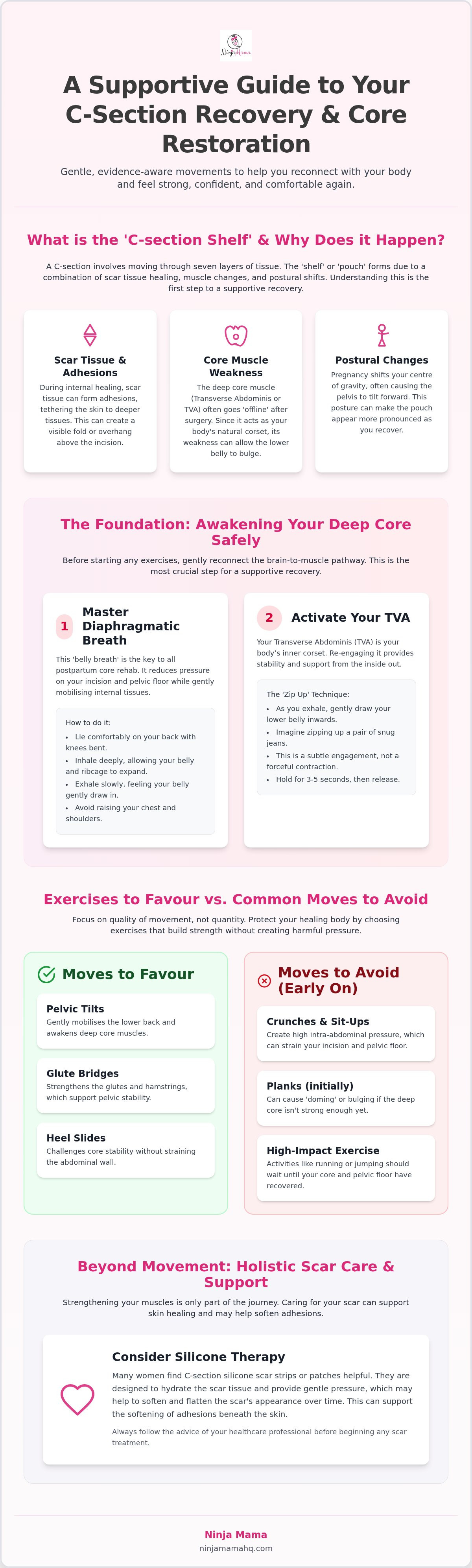
The shelf happens because of a combination of internal healing and muscle changes. While your skin heals on the outside, the deeper layers are busy creating scar tissue. Sometimes, this tissue forms adhesions, which act like a bit of internal glue. These adhesions can tether your skin to the underlying tissue, creating a visible fold or bulge. At the same time, your deep core muscle, the Transverse Abdominis (TVA), often goes 'offline' after surgery. Since the TVA acts like your body's natural corset, its temporary weakness allows the lower belly to shift outward.
Your posture also plays a cheeky role. During pregnancy, your centre of gravity shifted, often leading to an anterior pelvic tilt where your pelvis dips forward. This tilt can make any existing pouch appear more pronounced, even as your muscles begin to recover.
The Role of Scar Tissue and Adhesions
Think of adhesions as a silent tug-of-war happening under your skin. When scar tissue tethers the incision site to the abdominal wall, the skin above it has nowhere to go but out and over. This is why softening the scar is just as important as strengthening the muscles underneath. Many women find that using C-section silicone scar patches may help support the softening of these adhesions by providing hydration and gentle pressure. It is also helpful to distinguish between excess skin and Diastasis Recti, which is a separation of the outer abdominal muscles. While the shelf is often related to the incision itself, muscle separation requires its own specific, gentle approach to repair.
Why Traditional Crunches Can Make the Pouch Worse
It is tempting to jump straight into crunches to 'blast' the belly, but this can actually backfire. Standard crunches target the superficial 'six-pack' muscles, which can create high intra-abdominal pressure. This pressure often pushes outward against your healing incision and weakened pelvic floor, potentially making the pouch look more prominent. Instead of 'crunching up', your focus should be on 'drawing in' and 'zipping up'. This internal engagement protects your incision site while slowly reawakening the deep core fibres that provide real, lasting stability.
The Foundation: Awakening Your Deep Core Muscles Safely
Before you even think about hitting the gym or lacing up your runners for a jog, there is a much more important step to take. You need to reconnect the brain-to-muscle pathway that surgery often disrupts. Think of it as gently knocking on a door to see if anyone is home. After a caesarean, your nerves and muscles have been through a lot. Jumping straight into weights or cardio without this foundation can lead to injury or simply frustrate your progress. Re-establishing this connection is a vital part of c-section scar healing australia, ensuring your body feels supported from the inside out.
Mastering the Diaphragmatic 'Belly' Breath
Diaphragmatic breathing is the essential foundation of all postpartum core rehabilitation. When you breathe deeply into your lower ribs rather than just your chest, you reduce the downward pressure on your pelvic floor and incision site. This 'belly breath' also helps to gently mobilise the internal tissues. There is a surprising link between your breath and the relaxation of tight scar tissue; as you expand your ribcage, you encourage blood flow and flexibility to the area. Many mums find that wearing comfortable, high-waisted disposable underwear provides the gentle support needed to feel secure while practising these deep breaths in those early weeks.
Activating the Transverse Abdominis (TVA)
Visualise your TVA as your body's internal corset. It's the deep muscle layer that wraps around your midsection to support your spine and help flatten the belly. To find it, try the 'Zip Up' technique. Imagine a tiny zip starting at your pubic bone and slowly pulling it up toward your belly button. It should be a subtle, gentle engagement of the lower abdominal wall without any sharp pain or straining. While you do this, keep an eye on your tummy. If you see 'doming' or 'coning' (a ridge popping out along the midline), it means you're pushing out rather than drawing in. Ease back. Focus on that gentle 'hug' around your middle rather than a forceful contraction.
Setting realistic expectations is key. The fourth trimester is a time for healing, not for pushing limits. Your recovery journey will likely take months, not weeks, and that is perfectly okay. Most mums find that waiting for GP clearance at the 6-8 week mark is the safest way to transition from these gentle breath-work foundations into more structured core routines. Listen to your body, be patient with yourself, and celebrate every small win as you regain your strength.
Exercises to Favour vs. Common Moves to Avoid
Safety is the absolute priority when you're ready to start moving again. Before you begin any of these routines, always wait for the 'all clear' from your GP or a women's health physio. This usually happens at the six to eight-week mark, but every body is different. When you do start, listen closely to what your body is telling you. Sharp pain at the incision site or a feeling of pelvic heaviness are major red flags. If you feel these, stop immediately. In these early months, stability-based exercises are far superior to mobility-heavy moves because they protect the integrity of your c-section scar healing australia while slowly waking up your core. You aren't just training for aesthetics; you're training for functional strength to lift your growing bub without pain.
The 'No-Go' Zone: What to Skip for Now
It might be tempting to try and 'fix' the shelf with intense core work, but some moves do more harm than good. Planks and full sit-ups put an enormous amount of stress on a healing C-section scar and can actually increase the bulge by pushing the abdominal wall outward. You should also avoid heavy lifting that causes the 'Valsalva manoeuvre,' which involves holding your breath while straining. This creates internal pressure that your healing tissues aren't ready to handle yet. Save high-impact jumping for later, as your pelvic floor needs time to regain its strength and support your internal organs against the force of gravity during movement.
The 'Green Light' Movements
Low-impact movements are your best friend when you're looking to reduce the appearance of the pouch. Walking is the absolute best entry-level exercise for Aussie mums. It's gentle, gets the blood flowing, and helps with the mental load of new motherhood. Once you feel steady, focus on lateral movements and pelvic stabilisation to create a flatter profile. The glute bridge is a powerhouse move for this stage. It helps align your pelvis and supports the lower core without putting direct strain on your incision. Many mums find that wearing supportive underwear during these early walks helps everything feel held in place and secure.
Your Step-by-Step C-Section Pouch Recovery Routine
You have done the incredible work of reawakening your deep core connection. Now, it's time to put those foundations into a gentle, daily flow. This routine is designed to be simple and effective, something you can easily do on the living room floor while bub is napping. You don't need fancy equipment or hours of free time. Instead of counting dozens of reps, focus entirely on the quality of every single movement. If you feel your form slipping or your breath catching, that is your cue to rest. Postpartum progress is rarely linear, so remember to listen to your body’s signals daily.
Effective c-section scar healing australia involves more than just rest; it is about intentional, mindful movement that respects your surgical site. As you get stronger, you can slowly progress these moves by holding the engagement for a few extra seconds. Always move with a sense of "prepared calm," knowing that you are rebuilding your strength from the inside out.
Pelvic Tilts and Heel Slides
Start by lying on your back with your knees bent and feet flat on the floor. To perform a pelvic tilt, use your breath to gently flatten the small of your back against the ground. This small, rocking motion wakes up the lower abdominal wall without any strain. From this stable position, try a heel slide. Slowly slide one heel away from your body while keeping your back glued to the floor, then pull it back in. Watch out for these common mistakes:
- Arching your lower back as your leg extends.
- Holding your breath instead of using your diaphragmatic flow.
- Rushing the movement rather than feeling the TVA engage.
Modified Side-Lying Leg Lifts
Rolling onto your side is a wonderful way to take direct pressure off your surgical incision while still building strength. Stack your hips and knees, keeping a neutral spine. Gently lift your top leg just a few centimetres, focusing on the stability in your deep pelvic and hip regions. This isn't about how high you can lift; it's about keeping your torso still. These movements help support the tissues around your scar, encouraging flexibility and strength in the surrounding fascia. Many mums find that wearing supportive disposable underwear during these routines helps them feel more secure and held.
If you notice any pulling or discomfort around your incision during these moves, it might be time to focus on softening the area. You can proactively manage your recovery by using Ninja Mama C-section silicone scar patches, which are designed to hydrate the tissue and may help support the flattening of the 'shelf' look over time.
Beyond Movement: Holistic Scar Care and Support
Movement is a fantastic way to reclaim your strength, but it is only one half of the recovery equation. To truly address the 'shelf' and feel comfortable in your skin again, you need to look at external support and internal nourishment. Think of it as a holistic partnership between your muscles and your skin. While your core works from the inside, specialised care supports the surface. This dual approach is often the missing link in c-section scar healing australia, helping you feel more like yourself with every passing week.
Silicone Patches: The Secret to Softening Scar Tissue
If your scar feels tight, itchy, or raised, it can make even the gentlest pelvic tilt feel uncomfortable. This is where Ninja Mama C-section silicone scar patches come into play. These medical-grade strips create a protective, hydrated environment that mimics the skin's natural barrier. By providing gentle pressure and locking in moisture, they may help support the flattening and softening of scar tissue. When the tissue is more pliable, your core exercises feel smoother and less restrictive. It is about reducing the 'tug-of-war' between your skin and the muscles underneath, allowing for a more comfortable movement journey.
Support Garments for Confidence and Comfort
Have you ever felt like your middle needs a gentle hug while you walk? High-waisted disposable postpartum underwear is a total lifesaver during those first few months of recovery. Unlike regular undies that often sit right on your incision, these are designed to sit high and stay put. They provide gentle, soothing compression that helps you feel secure while you're practising your heel slides or going for a stroll around the block. Ninja Mama supports your movement journey from day one by ensuring your incision is protected from irritation, allowing you to focus on your breath and your bub rather than your waistband.
Don't forget that tissue repair also requires fuel from within. Nourishing your body with recovery-focused treats, like a warm organic lactation chocolate drink, can provide a comforting moment of self-care. It's about being kind to yourself during this transition. Your body has done something incredible. By focusing on both movement and specialised care, you're creating a comprehensive plan for c-section scar healing australia that respects your body’s pace and your need for comfort.
Embrace Your Postpartum Strength and Confidence
You've taken the first steps toward reclaiming your core strength and confidence. Managing the 'shelf' is about more than just the right exercises; it's a holistic approach to c-section scar healing australia. By focusing on deep diaphragmatic breathing, prioritising stability over intensity, and supporting your skin with silicone therapy, you're giving your body exactly what it needs to thrive. It's a slow process, but every gentle movement counts toward feeling like yourself again.
Our essentials are designed by mums, for mums, and are recommended by postpartum health professionals to ensure you feel secure. With over 1,000+ 5-star reviews from Aussie mums, we know what it takes to support a comfortable recovery. You deserve to feel strong and beautiful in your own skin once more.
Ready to give your recovery the premium care it deserves? Shop our C-Section Recovery Essentials to support your journey and embrace this new chapter with prepared calm. You're doing an incredible job, mama!
Frequently Asked Questions
When can I safely start exercises to reduce my C-section pouch?
You should wait for the official 'all clear' from your GP or women's health physio, which typically happens around the six to eight week mark. Starting too early can disrupt the delicate layers of your incision. While you wait, you can often begin gentle diaphragmatic breathing to help with c-section scar healing australia. This foundational step reconnects your brain to your core muscles without putting physical strain on your surgical site or pelvic floor.
Will the C-section shelf ever completely go away with exercise?
While results vary for every mum, many women find that the shelf can be significantly reduced through a combination of targeted core exercises and scar management. The appearance is often caused by a mix of scar tissue adhesions and deep core weakness. By softening the scar and reawakening your Transverse Abdominis, you can help the area lie flatter. It is about progress and feeling strong in your body again rather than achieving total perfection.
Can I do planks or crunches if I have a C-section pouch?
It is best to avoid planks and crunches in the early stages of your recovery journey. These movements create high intra-abdominal pressure that can push outward against your healing incision, potentially making the pouch look more pronounced. Instead, focus on low-impact moves like pelvic tilts and heel slides. These exercises build strength from the inside out without the risk of straining your scar or causing doming in your abdominal wall during the movement.
Does scar massage really help reduce the appearance of the shelf?
Many women find that gentle scar massage is a game changer for reducing the appearance of the shelf. Once your incision is fully closed and your doctor gives the okay, massaging the area may help break down internal adhesions that tether the skin to the muscle. This increased flexibility allows the tissue to sit more naturally. Combining massage with silicone therapy is a common strategy used by Aussie mums to support their recovery journey.
Is the C-section pouch caused by fat or muscle weakness?
The pouch is usually a combination of three factors: scar tissue adhesions, deep core muscle weakness, and a small amount of postpartum fat. Because the incision tethers the skin, any tissue above it can bulge outward, creating that 'shelf' look. Strengthening your deep core and managing the scar tissue are the most effective ways to address the physical structure of the pouch, helping you feel more supported and comfortable in your clothes once again.
How often should I do these core exercises to see results?
Consistency is much more important than intensity when you are starting out. Aim for five to ten minutes of gentle core work three or four times a week. You don't need a long workout to see results; quality of movement is the key. Listen to your body and rest if you feel tired or sore. Over time, these small, regular sessions will help build the stability needed for c-section scar healing australia and long-term health.
What should I do if my scar hurts while I am exercising?
You must stop exercising immediately if you feel any sharp pain, pulling, or stinging around your scar. Pain is your body's way of saying it isn't ready for that specific movement yet. Check your form and ensure you aren't holding your breath. If the pain persists, it is a good idea to consult your women's health physio. They can check for adhesions or other issues that might be causing the discomfort during your routine.
Can I use silicone scar patches while I am also doing core exercises?
You can definitely wear silicone scar patches while you perform your core routine. In fact, many mums find they provide a sense of security and protection for the incision site during movement. The patches help keep the tissue hydrated and may help support the softening of adhesions while you work on your core stability. Just ensure the area is clean and dry before applying the patch for the most effective and secure fit.

Article by
Louise Beever
Louise Beever is the founder of Ninja Mama, an Australian postpartum recovery brand focused on creating premium, practical recovery essentials for new mothers. Since launching Ninja Mama in 2018, Louise has worked closely with thousands of postpartum women and healthcare retailers to better understand the realities of recovery after birth. Her work focuses on postpartum preparation, recovery support, and improving awareness around the fourth trimester.
Remember Mamas
The information provided in this article is intended for general educational and informational purposes only and should not be considered medical advice. Always seek guidance from your doctor, midwife, lactation consultant, or qualified healthcare professional regarding your individual circumstances, pregnancy, birth, or postpartum recovery.