
Did you know that over 40% of Aussie mums now welcome their little ones via caesarean? While your scar is a badge of strength from the day you met your baby, it's completely normal to feel a bit apprehensive about the healing process or wonder how to improve c-section scar appearance as you navigate the fourth trimester. Whether you're worried about your clothes rubbing against the incision or simply want to feel more like yourself again, you aren't alone in this journey.
We understand that the early weeks can feel like a delicate balancing act between managing physical discomfort and caring for a newborn. You might be feeling a bit lost regarding when it's actually safe to start treatments or how to tell if your healing is on the right track. This guide is here to replace that uncertainty with a sense of prepared calm. We'll walk you through the biological stages of caesarean healing and provide practical, sisterly advice on how to support your body's natural recovery from day one all the way through to year two.
In this article, we've organised a week-by-week checklist that covers everything from identifying early signs of infection to the best time for starting scar massage. We've curated a system to help you work towards a flat, faded scar while ensuring you feel confident and comfortable in your own skin.
Key Takeaways
- Understand the three biological stages of healing to support your body's natural recovery from the very first day.
- Learn how to improve c-section scar appearance by managing tissue adhesions and encouraging mobility as your scar matures.
- Discover why a persistent itch is often a positive sign of nerve regeneration and how to identify if your scar requires specialist attention.
- Identify essential recovery tools for Aussie mums, including the role of hydration and supportive undergarments in the fourth trimester.
Table of Contents
The First 7 Days: Protection and the Inflammatory Stage
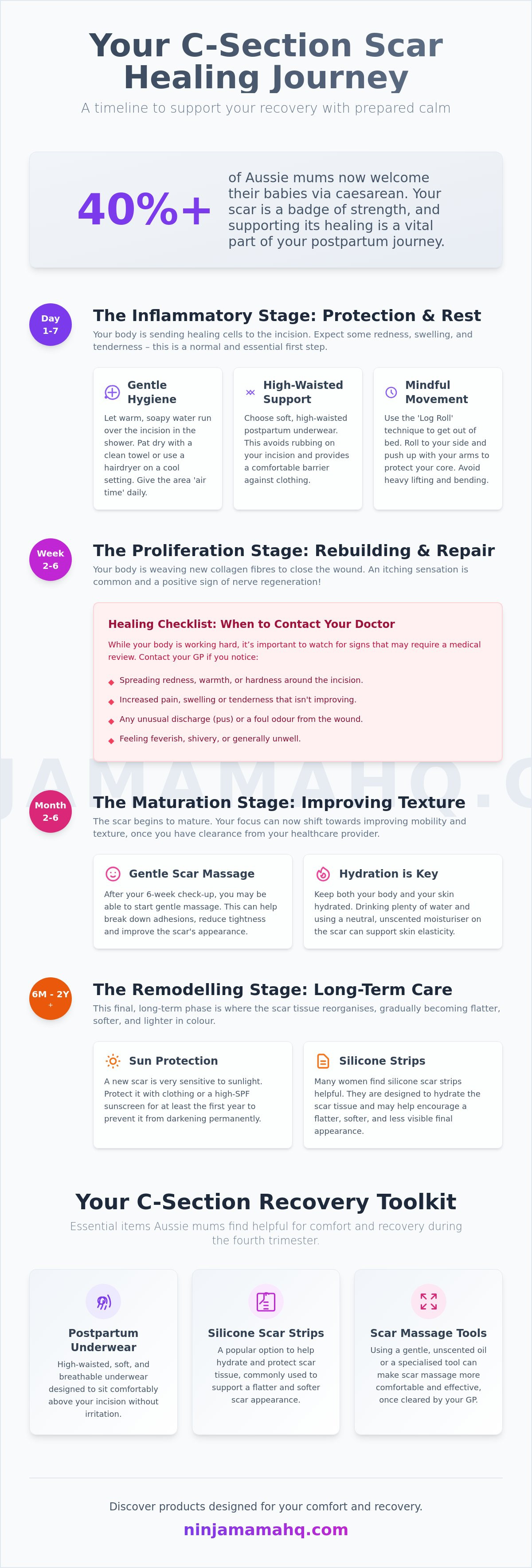
The first seven days after your Caesarean section are all about protection. Right now, your body is in the inflammatory stage. It's busy sending white blood cells to the area to prevent infection and starting the clotting process. You'll likely notice your incision looks red, feels slightly swollen, and is tender to the touch. This is totally normal! While you might be eager to learn how to improve c-section scar appearance, the priority this week is simply letting your body do its foundational work without extra stress.
Transitioning from hospital to home can be a bit of a juggle. Setting up a "recovery station" is a game changer for your comfort. Keep everything you need, like nappies, wipes, and snacks, at waist height so you aren't bending or lifting. When you need to get out of bed, use the "Log Roll" technique. Roll onto your side, drop your legs off the edge, and use your arms to push yourself up. This keeps your abdominal muscles from straining and protects your incision from unnecessary pulling during these first critical days.
Hygiene and Wound Safety
Keeping the area clean doesn't mean you need to scrub. When you're in the shower, just let warm, soapy water run gently over the incision. Avoid direct pressure from the showerhead. Once you're out, pat the area dry with a fresh, clean towel. If it feels too tender, many mums find that using a hairdryer on the "cool" setting is much more comfortable. Aim for about 10 minutes of "air time" each day. Letting the scar breathe supports tissue health and keeps the area dry, which is vital for preventing irritation and supporting how to improve c-section scar appearance in the long run.
The Role of High-Waisted Support
Your regular undies probably won't feel very friendly right now. Elastic bands that sit right on the bikini line can cause painful friction and irritation. This is where postpartum disposable underwear becomes your best friend. They're designed for comfort and recovery, providing a soft, high-waisted barrier that won't snag on your staples or stitches. Seeing your scar for the first time can feel quite emotional. It's a significant change to your body, and it's okay to take a moment to process that. This is just the beginning of your journey, and focused care now sets the stage for a flatter, faded result later.
Weeks 2 to 6: The Proliferation Stage and Infection Checklist
Welcome to the proliferation stage! This is where the real magic happens behind the scenes. Between weeks two and six, your body is busy weaving new collagen fibres to knit those tissues back together permanently. While you’re focused on C-section recovery, it's normal to notice some changes in the mirror. You might see a bit of puffiness above the incision, often called a 'shelf.' Don't panic; this is usually just inflammation and tissue settling into place during this active healing window. It isn't necessarily how the area will look forever, but it's a sign your body is working hard.
Have you started feeling a persistent tickle or itch? That 'itch factor' is actually a great sign. It means your nerves are regenerating and the skin is successfully repairing itself. It’s a bit annoying, but it’s proof your body is doing exactly what it should. As you approach your six-week check-up, your GP or obstetrician will check the scar’s integrity to ensure everything is closing beautifully. This is a perfect time to ask about how to improve c-section scar appearance through gentle movement and hydration as you transition into the next phase of motherhood.
Signs of Infected C-Section Scar Checklist
Even though you're past the initial surgery, keeping a close eye on the site is vital for a smooth recovery. Watch for these red flags that suggest you need a medical review:
-
Spreading redness: A healthy scar is pink or light red, but if that hue turns dark and starts expanding or feels hot to the touch, it's time to call the doctor.
-
Oozing or discharge: A small amount of clear fluid is fine, but yellow or green pus is a sign of trouble.
-
Foul odours: Any unusual or unpleasant smell from the incision site requires immediate attention.
-
Fever and pain: If your discomfort is ramping up instead of settling down, or if you develop a fever, don't wait for your scheduled appointment.
Comfort Strategies for New Skin
As tempting as it is, try your best not to scratch that itch. Scratching can create tiny micro-tears in the fresh tissue, which can actually hinder your goal of how to improve c-section scar appearance. Instead, try placing perineal ice packs over your clothing. The cooling sensation is incredibly soothing and helps calm the nerves without damaging the skin. You can also continue using your peri bottle for gentle cleansing; it’s a lovely way to keep the area fresh without any bending. If you're looking for a complete way to support your body, our postpartum recovery kits offer curated essentials to keep you comfortable during these first six weeks.
Months 2 to 6: Maturation and Improving Scar Texture
You've made it through the hazy early weeks, and now your body is entering the maturation stage. This is a long, quiet phase where collagen fibres begin to reorganise and lie flatter. If you're wondering how to improve c-section scar appearance, this window is your golden opportunity. While the surface might look healed, those internal layers are still very much in flux. We often call this the "Scar-versary" mindset; honouring the fact that your body is still doing heavy lifting deep beneath the skin even months later.
During this time, you might notice the scar feels a bit "stuck" or tight when you stretch or twist. These are called adhesions, where the scar tissue attaches to underlying layers like muscle or fascia. Mobility is the key to preventing that tethered feeling. However, before you jump into any active treatments, ensure your wound is 100% closed with no scabbing or oozing. This usually happens around the 6 to 8 week mark, but always check with your GP first. Touching your scar for the first time can feel incredibly daunting or even a bit emotional, and that's completely okay. Take it slow; your body has done something amazing.
The Power of C-Section Scar Massage
Once you're cleared for touch, massage is a brilliant way to encourage flexibility. Start with desensitisation. Use gentle, circular strokes on the skin around the scar before you ever touch the incision itself. This helps your brain get used to the sensation. Once you're comfortable, you can move into mobilisation techniques. Gently move the skin up, down, and side-to-side to prevent those adhesions from tightening. Consistency is far more important than intensity. Just five minutes of daily, gentle work is much more effective for tissue health than one long, aggressive session.
Silicone Therapy for a Smoother Finish
If you're looking for an evidence-based way to support a flatter, less red result, silicone is the gold standard. It works by creating a hydrated "micro-climate" over the tissue, which signals your body to stop over-producing collagen. Many Aussie mums find that using C-section silicone scar patches helps significantly with both texture and colour. For the best results, you'll want to wear these patches for 12 to 24 hours a day. It’s a marathon, not a sprint, so aim to use them consistently for several weeks to see the most beautiful improvement in how to improve c-section scar appearance.
6 Months to 2 Years: Long-Term Remodelling and Protection
You’ve passed the half-year mark, and your body is now in the home stretch of the healing journey. This final remodelling phase is when your scar reaches its permanent colour and strength. If you’re still looking at how to improve c-section scar appearance, don’t feel like you’ve missed the boat. While the most dramatic changes happen early on, the tissue continues to refine itself for up to two years after birth. During this window, the scar usually transitions from a pink or purple hue to a silvery white or light tan, depending on your skin tone.
Do you still feel a bit of numbness or a "pins and needles" sensation around the incision? It’s incredibly common. Those tiny nerves were severed during surgery and take a long time to find their way back to each other. Sometimes, the body also over-produces collagen, leading to different types of scarring. Hypertrophic scars are raised and red but stay within the original incision line. Keloid scars, however, are thicker and actually grow beyond the edges of the original wound. If you notice your scar is becoming significantly thicker or wider during this phase, it’s worth seeing a specialist or a pelvic floor physiotherapist for targeted advice.
Aussie mums need to be particularly careful with sun protection. Our UV levels are intense, and fresh scar tissue is extremely sensitive to sunlight. Even if you’re wearing a swimsuit, UV rays can penetrate the fabric and cause the scar to darken permanently, a process called hyperpigmentation. If you’re heading to the beach or lounging by the pool, apply a high-SPF zinc or keep the area covered to ensure the pigment stays as light as possible. If you're noticing your scar is still quite raised or red during this phase, continuing with C-section silicone scar patches can help support that final flattening process.
Addressing the "C-Section Shelf"
Many women notice a small "shelf" or protrusion of tissue just above their scar. This isn't always about body fat; it’s often caused by the scar being tethered down to the underlying muscle while the skin above remains loose. Core-safe movement and continued, gentle massage can help soften this tethering and improve the overall contour of your tummy. Every body heals differently and the "shelf" is a common, normal variation.
Future Pregnancies and Your Scar
If you're planning for another baby, you might wonder how your scar will behave as your skin stretches again. The tissue is remarkably resilient, but internal healing is just as important as the external appearance for future deliveries. If you’re considering a VBAC (Vaginal Birth After Caesarean), your healthcare team will discuss scar integrity with you. Keeping the tissue mobile through the massage techniques we’ve discussed helps the skin stay supple and prepared for the beautiful changes of a subsequent pregnancy.
Your C-Section Recovery Toolkit: Aussie Mum Essentials
Your recovery isn't just about what you put on your skin; it's about how you nourish your body from the inside out. Building strong, healthy collagen requires the right building blocks. Focus on a protein-rich diet and stay hydrated to help your tissues knit back together with resilience. While you're out and about, keep a small "cough pillow" in the car. Placing it between your incision and the seatbelt provides a much-needed buffer against bumps and sudden stops, making those first few trips to the shops or the paediatrician much more comfortable.
The foundation of your external toolkit should be comfort. For the first month, many women find that postpartum disposable underwear is an absolute essential. They offer a soft, friction-free barrier that won't irritate your healing skin or catch on any remaining staples. By choosing gear designed specifically for this transition, you're giving your body the space it needs to heal without the distraction of uncomfortable clothing.
The Daily Care Routine
Consistency is your best friend when learning how to improve c-section scar appearance. Establishing a simple system helps you stay on track without feeling overwhelmed. In the morning, focus on gentle cleansing followed by applying silicone scar patches to create that protective micro-climate. By the afternoon, if you've been on your feet "mum-ing" all day, use cooling packs to settle any swelling. Finally, dedicate five minutes in the evening to your scar massage. This keeps the tissue mobile and soft while giving you a quiet moment of self-care before bed.
When to Seek Professional Help
While most scars heal beautifully with time and care, sometimes you need a little extra support. A Women’s Health Physiotherapist can be a wonderful ally, especially for managing internal adhesions that feel tight or restrictive. If you notice your scar is becoming significantly raised, itchy, or painful after the first year, it might be time to discuss scar revision or steroid injections with your GP. There is no shame in seeking expert guidance to ensure you feel your best. Ready to support your healing journey? Explore our Australian-designed C-Section Recovery Essentials to find everything you need for a confident recovery.
Above all, remember that your scar is a badge of honour. It represents the incredible strength it took to bring your baby into the world. While we work on the aesthetics and comfort of the area, don't forget to celebrate the body that did something so miraculous. You're doing a brilliant job, mum.
Empower Your Postpartum Recovery
Your recovery is a marathon, not a sprint. By understanding the biological stages of healing; from that initial inflammatory phase to the long-term remodelling; you can support your body with confidence. The most important takeaways are to stay consistent with your daily care routine and protect your new skin from the intense Aussie sun. Whether it's five minutes of gentle massage or the regular use of premium medical-grade silicone, every small action helps your tissue stay mobile and soft.
Learning how to improve c-section scar appearance takes time, but you don't have to navigate this journey alone. We are an Australian owned and operated business, and our products are designed by mums, for mums. We've curated everything you need to feel comfortable and supported during your fourth trimester and beyond. If you're ready to invest in your wellbeing and support your body's natural healing, Shop the Ninja Mama C-Section Recovery Range today. You've done something incredible by bringing your little one into the world, so remember to be kind to yourself as you heal. You’re doing a brilliant job, mama.
Frequently Asked Questions
How do I know if my C-section scar is infected?
You can identify an infection by looking for spreading redness that feels hot to the touch, unusual discharge like yellow or green pus, or an unpleasant odour from the site. If you develop a fever or find your pain is increasing significantly instead of settling down, it's vital to contact your doctor immediately. Early detection is key to a smooth recovery and ensuring your long-term healing stays on the right track during the fourth trimester.
Is it normal for my C-section scar to be red and itchy?
It is completely normal for your scar to appear pink or red and feel quite itchy during the first few months. This "itch factor" usually indicates that your nerves are regenerating and your skin is successfully repairing itself. While the sensation is annoying, it’s a positive sign of progress. Just try to resist the urge to scratch, as this can hinder your goal of how to improve c-section scar appearance through the maturation phase.
When can I start using silicone scar strips after my C-section?
You should wait until your incision is fully closed and no longer scabbing or oozing before applying silicone scar strips. This milestone typically occurs around the six to eight week mark, but it’s always best to get the "all clear" from your GP or obstetrician first. Patience is essential for achieving a flatter finish, and using medical-grade silicone is one of the most effective ways to support how to improve c-section scar appearance long term.
What does a healthy C-section scar look like after 2 weeks?
At the two-week mark, a healthy scar will usually look like a thin, pink or red line that is starting to knit together. You might still see some slight swelling or bruising around the area, and it may feel tight or tender. The primary goal at this stage is to ensure the edges are staying closed and there are no signs of infection like spreading redness, heat, or unusual discharge from the incision site.
Can I use a peri bottle to clean my C-section incision?
Yes, using an upside down peri bottle is a brilliant and gentle way to keep your incision clean without applying any harsh pressure. Many mums find that letting warm, fresh water flow over the area is much more comfortable than using a washcloth in those early weeks. Simply pat the area dry very gently with a fresh towel or use a hairdryer on the cool setting afterwards to keep the site dry and happy.
Why is the skin around my C-section scar numb?
Numbness or a "pins and needles" sensation occurs because the tiny nerves in your abdominal wall were severed during the procedure. These nerves take a long time to find their way back together, and for some mums, the area can feel numb for several months or even years. While it feels strange, it is a very common part of the healing journey as your body works on internal repairs and tissue regeneration after surgery.
What is the "C-section shelf" and will it ever go away?
The "shelf" is a common protrusion of tissue just above the incision line, often caused by the scar being tethered to the underlying muscle while the skin above remains loose. While every body heals differently, many mums find that consistent scar massage and core-safe movement can help soften the shelf’s appearance over time. It’s a normal variation of healing and doesn't mean your body isn't recovering beautifully as you move through your postpartum journey.
How long should I wait before exercising after a C-section?
You should generally wait until your six-week postnatal check-up before starting any structured exercise program. Your doctor will assess your abdominal wall and scar integrity to ensure it's safe to begin gentle, core-safe movements. High-impact activities usually require a longer wait, often twelve weeks or more, to allow your internal layers to regain their strength. Always listen to your body and progress slowly to ensure you're supporting your long-term physical wellbeing.

Article by
Louise Beever
Louise Beever is the founder of Ninja Mama, an Australian postpartum recovery brand focused on creating premium, practical recovery essentials for new mothers. Since launching Ninja Mama in 2018, Louise has worked closely with thousands of postpartum women and healthcare retailers to better understand the realities of recovery after birth. Her work focuses on postpartum preparation, recovery support, and improving awareness around the fourth trimester.
Remember Mamas
The information provided in this article is intended for general educational and informational purposes only and should not be considered medical advice. Always seek guidance from your doctor, midwife, lactation consultant, or qualified healthcare professional regarding your individual circumstances, pregnancy, birth, or postpartum recovery.