

You’re standing in front of the mirror, months after bub has arrived, wondering why your favourite pre-pregnancy bra still won’t do up. It’s a confusing moment because the scales might say one thing, but your rib cage feels like it’s telling a completely different story. This common experience, often called Postpartum Rib Flare, can leave you feeling like your midsection has permanently widened. You aren't alone in feeling that nagging tension in your upper back or the frustration of not being able to take a truly deep, satisfying breath while navigating the beautiful chaos of new motherhood.
Understanding why your ribs expanded is the first step toward feeling like yourself again. We’re here to help you discover the science behind these changes and how you can gently support your body back into alignment. This guide covers everything from the underlying causes of rib expansion to practical tips for immediate comfort. We will also share simple, effective movements designed to improve your posture and breathing mechanics, ensuring you feel supported and empowered throughout your fourth trimester recovery. You deserve to feel comfortable and confident in your body as you move through this season of life.
Key Takeaways
- Understand how pregnancy hormones and physical expansion lead to Postpartum Rib Flare and why it is a common part of the fourth trimester.
- Explore the "canister" model of the core to see how your rib position directly affects your pelvic floor health and breathing quality.
- Learn the difference between skeletal rib changes and muscular abdominal separation to better manage your postnatal recovery journey.
- Master simple exercises like 360-degree breathing and thoracic mobilisation to gently encourage your ribs back into alignment.
- Discover immediate comfort hacks, such as using bra extenders, to relieve that tight-band feeling around your midsection while you heal.
What is Postpartum Rib Flare? (And No, It’s Not Just You!)
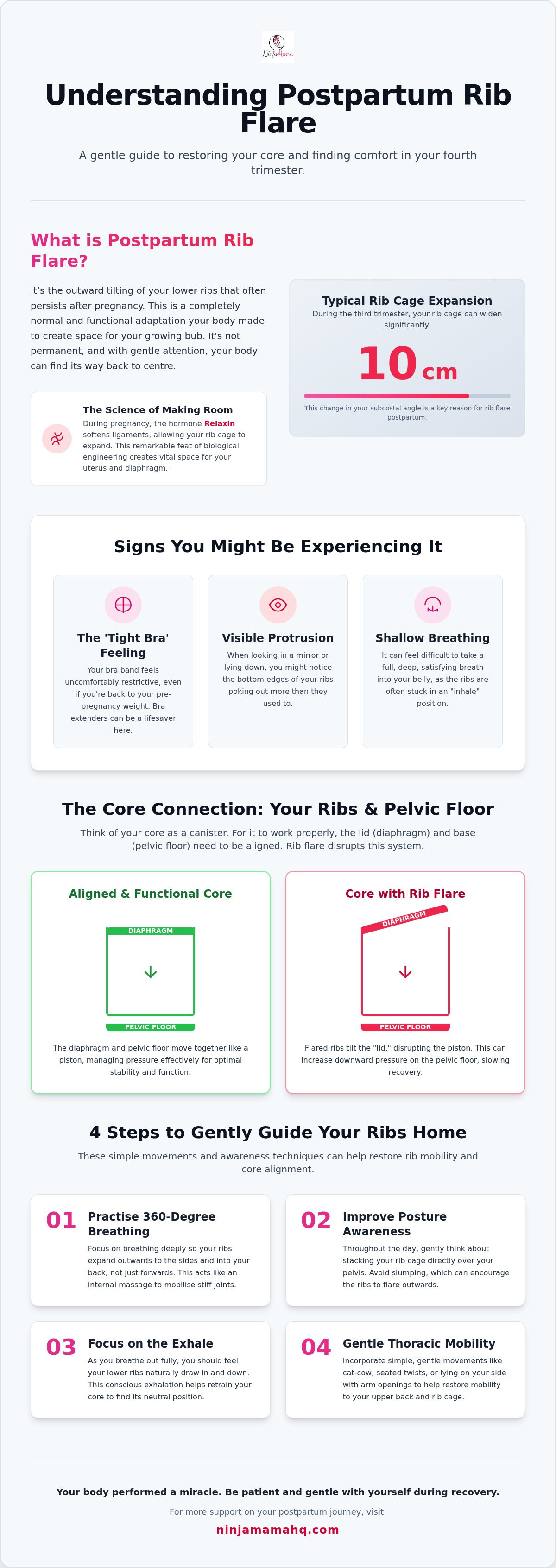
Have you noticed your rib cage feels different since having your baby? Perhaps your favourite pre-pregnancy tops fit everywhere else, but they feel strangely tight across your chest. This isn't just your imagination. Postpartum Rib Flare is the outward tilting or protrusion of the lower ribs that often persists after pregnancy. It’s a completely natural, functional adaptation your body made to accommodate your growing bub. During pregnancy, your body produces a hormone called Relaxin. This clever hormone softens your ligaments and connective tissues, allowing your bones to shift and expand. While we often talk about the pelvis widening, your ribs also undergo a massive transformation to make space for your uterus and moving organs.
Validating this experience is vital because many women feel their body has "widened" permanently. The tape measure doesn't lie; your physical structure has actually moved. This skeletal shift often occurs alongside Diastasis recti, as the pressure changes within your abdomen affect both your bones and your muscles. Understanding that your ribs moved for a very good reason can help replace anxiety with a sense of prepared calm as you begin your recovery.
The Science of Making Room for Bub
As your pregnancy progresses, your uterus expands upwards. To make room for this growth, your internal organs shift, and your diaphragm is pushed higher into your chest cavity. Research indicates that the rib cage can actually widen by up to 10cm during the third trimester. This expansion isn't just about width. It also involves a change in the subcostal angle, which is the inverted V-shape where your ribs meet at the bottom of your breastbone. This angle increases significantly to create a larger internal volume. It’s a remarkable feat of biological engineering, but it can sometimes leave your ribs in a flared or open position long after birth. Postpartum Rib Flare is essentially your body staying in that expanded pregnancy state.
Signs You’re Experiencing Rib Flare
Identifying rib flare is usually about how your body feels and looks in everyday moments. You might notice:
- The tight bra syndrome: Your bra band feels uncomfortably restrictive, even if your weight has returned to its pre-pregnancy range. Many mums find that bra extenders are a total sanity saver during this transition.
- Visible protrusion: When you look in the mirror or lie flat on your back, you might see the bottom edges of your ribs poking out further than they used to.
- Shallow breathing: Because the ribs are stuck in an inhale or flared position, it can feel difficult to take a full, deep breath into your belly.
If these signs sound familiar, take heart. Your body did exactly what it needed to do to keep bub safe. Now, it just needs a little gentle guidance to find its way back to centre.
The Breathing Connection: Diaphragms and Pelvic Floors
Think of your core as a functional canister. The diaphragm sits at the top as the lid, while your pelvic floor forms the base. For this system to work efficiently, the lid needs to be stacked directly over the base. When you experience Postpartum Rib Flare, it’s as if the lid of the canister has been tilted open. This misalignment makes it incredibly difficult for your core to manage internal pressure, which is why you might feel a lack of stability or strength in your midsection after bub arrives.
Many new mums unknowingly fall into a pattern of "chest breathing." This involves short, shallow breaths that only move the upper chest, leaving the lower ribs stuck in that flared, outward position. To encourage your ribs to move back toward the centre, you need to practice the 360-degree breath. This technique involves breathing deeply so that your ribs expand outwards to the sides and into your back, not just forward. It’s a gentle way to mobilise the joints and tissues that became stiff during pregnancy. This movement acts like a massage from the inside out, helping to restore rib mobility.
Why Your Ribs and Pelvic Floor are Best Mates
Your diaphragm and pelvic floor are designed to move together like a piston. As you inhale, both should move downwards; as you exhale, they both lift. When your ribs are flared, this piston doesn't fire correctly. This can lead to increased downward pressure on your pelvic floor, potentially slowing your recovery. As mentioned in this guide from UF Health on abdominal separation, internal pressure management is vital for healing. By addressing your rib position, you are directly supporting your pelvic floor health too. It is all connected!
The Habit of "Pregnancy Posture"
During those final weeks of pregnancy, you likely developed a "rib thrust" posture. This is where you arch your lower back and push your ribs forward to balance your bump. Unfortunately, your brain often keeps this posture "locked in" even after birth. You might also notice:
- The "mum-slouch" during long feeding sessions that keeps ribs compressed.
- Shoulders rounding forward, which prevents the ribs from dropping.
- A persistent arch in your lower back when standing.
This "locked in" state makes the flare feel permanent, but it's really just a habit your muscles have learned. Breaking this habit starts with awareness and gentle movement. While you’re working on these breathing patterns, don't let physical discomfort distract you. Many women find that bra extenders are a simple way to reduce the immediate pressure on your flared ribs, allowing you to focus on your recovery with less irritation.
Rib Flare vs. Diastasis Recti: What’s the Difference?
It’s very common to feel confused when your body looks and feels so different after birth. You might look in the mirror and see your midsection protruding, wondering if it’s just your ribs or if your abdominal muscles have separated. While they often appear together, Postpartum Rib Flare and Diastasis Recti are actually two distinct issues. Think of rib flare as a skeletal or positional change where your lower bones have tilted outwards. In contrast, Diastasis Recti is a muscular condition where the connective tissue between your abdominal muscles has stretched and thinned. Because your ribs and muscles are physically connected, they often influence each other. A flare can create a constant tugging sensation on your tummy muscles, which is why a holistic view of your fourth trimester recovery is so important.
There is a persistent myth that "waist trainers" or aggressive "cinchers" are the secret to getting your pre-baby shape back. In reality, these can actually make a rib flare worse. When you tightly wrap your midsection, that internal pressure has to go somewhere. Often, it gets pushed straight down onto your pelvic floor or forced upwards, keeping your ribs stuck in that flared, "open" position. True recovery comes from restoring function and mobility, not from squeezing your body into a restrictive garment that prevents you from breathing properly.
Identifying the Overlap
Because your abdominal muscles attach directly to your lower ribs, the two conditions are often linked. When your ribs stay flared, they pull on the linea alba (the midline of your stomach), which can make it much harder for abdominal separation to heal. You might notice:
- A "doming" or "coning" effect down the centre of your tummy when moving.
- That "sucking it in" doesn't actually help your ribs drop down.
- Persistent lower back pain that feels related to your core stability.
Instead of trying to force your body back into place, we always suggest booking in with a Women’s Health Physio. They are the absolute experts at assessing how your ribs, breath, and muscles are working as a team. Getting a professional assessment can replace guesswork with a sense of prepared calm, knowing exactly what your body needs to heal.
Myth-Busting: Can You "Snap Back"?
The "snap back" culture we see online is not only unhelpful, it is scientifically inaccurate. Your body spent nine months expanding and shifting to grow a miracle; it’s simply not designed to "snap" anywhere. Patience and gentle, intentional movement will always be more effective than aggressive waist cinching. We need to move away from the idea of restriction and focus on how well our bodies can move and support us. Rib flare recovery is a marathon of mobility, not a sprint of restriction.
While you are working on your mobility and core connection, focus on small ways to improve your daily comfort. If your ribs are feeling sensitive or your midsection feels wider than usual, using bra extenders can provide immediate relief from that "squeezed" feeling. This allows you to focus on your exercises without the constant irritation of a tight band around your flared ribs.
5 Steps to Gently Narrow Your Ribs Post-Birth
Guiding your body back into alignment after pregnancy is about gentle persistence rather than force. Because Postpartum Rib Flare involves both your bones and your breathing habits, we need a system that addresses both. These five steps are designed to fit into your busy life as a new mum, helping you regain comfort and core stability one breath at a time.
- Step 1: Master the 360-degree breath. Instead of breathing into your chest, focus on sending air into the sides and back of your rib cage. Imagine your ribs opening like an umbrella.
- Step 2: Mobilise your thoracic spine. If your upper back is stiff, your ribs will stay "stuck" in an open position. Gentle rotations help create the space needed for your ribs to drop.
- Step 3: Stop the "upper ab grip". Many mums subconsciously "suck in" their tummy. This actually pushes your ribs up and out. Focus on letting your belly soften as you inhale.
- Step 4: Organise your feeding posture. Use pillows to bring bub to your breast or bottle, rather than slouching down. This prevents your ribs from being compressed or thrust forward for long periods.
- Step 5: Engage your obliques. Your side abdominal muscles act like reins for your rib cage. Strengthening them helps gently "pull" the flared ribs back down and in.
Practical Exercises for Busy Mums
You don't need a gym to start your recovery. The "Rib Hug" is a simple tool you can use anywhere. Place your hands around your lower ribs. As you exhale, use your hands to gently guide your ribs down and toward each other. This physical feedback helps your brain remember where your ribs should sit. For upper back mobility, try "Cat-Cow" on all fours or gentle thoracic rotations while sitting. If you feel one side is more flared than the other, side-lying breathing is a game changer. Lie on your "tucked" side and breathe deeply into the flared side to encourage movement.
The "Exhale with Effort" Rule
One of the best ways to manage Postpartum Rib Flare is to "blow as you go." Whenever you lift bub, pick up the nappy bag, or push the pram up a hill, start with a long, steady exhale. This naturally engages your deep core and encourages your ribs to close. It turns every daily task into a mini-rehab session. While you’re working on these movements, don't suffer through the irritation of tight clothes. You can find immediate relief and room to breathe by using Ninja Mama bra extenders, which are the perfect secret weapon for rib flare comfort.
Comfort Strategies for Your Recovery Journey
While the exercises and breathing techniques we’ve discussed are vital for long term alignment, you need to feel better right now. Recovery is a journey, and your body deserves to be comfortable while it does the hard work of healing. Postpartum Rib Flare can make even the simplest tasks, like getting dressed or sitting down to feed, feel uncomfortably restrictive. We believe in a "prepared calm" approach. This involves having the right tools on hand to manage the physical sensations of your changing body so you can focus on bonding with your new bub. Practical comfort solutions are often the missing piece in the recovery puzzle.
Solving the "Tight Bra" Problem
One of the biggest frustrations for new mums is that their favourite bras simply won't do up around the band. It’s incredibly tempting to rush out and buy an entirely new wardrobe, but remember that your rib cage is still in a state of flux. Your ribs moved over many months, and they need time to settle back. Instead of spending a fortune on new sizes that might only fit for a short season, bra extenders are a total sanity saver. They give you those extra few centimetres of breathing room, instantly relieving the pressure on your flared ribs. We suggest choosing soft, wire-free bras that won't dig into your sensitive tissues while you work through your mobility exercises. This small adjustment can transform your daily comfort levels.
Soothing the Tension
The physical shift of your ribs often leads to compensatory tension in your upper back and chest. When your ribs are flared, the muscles in your mid-back often work overtime to try and find stability. Many women find that perineal ice packs, when used as a warm compress, can provide incredible relief for this upper back tension. Simply warm them up according to the instructions and place them between your shoulder blades to help those tight muscles relax and soften. It feels like a warm hug for your tired back.
Don't forget the power of a warm sitz soak. While these are famous for perineal care, the magnesium and essential oils in a warm bath may help support overall muscle relaxation and reduce the stress levels that keep your body in a "tense" posture. Self-care isn't a luxury; it’s a necessity during the fourth trimester. For a truly holistic approach to your healing, you might like to explore our guide on the Ultimate Postpartum Self Care Kit. Taking care of your own well-being allows you to show up as the best version of yourself for your little one.
Moving Forward with a Stronger, More Aligned You
Your body has performed an incredible feat. While Postpartum Rib Flare might feel like an unwelcome permanent change, it’s actually a sign of how brilliantly your structure adapted to grow your bub. By focusing on 360-degree breathing and the gentle mobility exercises we've explored, you can restore the natural alignment of your core canister. Remember that recovery isn't about rushing to "snap back" but about providing your body with the nurturing support it needs to heal from the inside out. Progress takes time, and every deep, intentional breath is a step in the right direction.
At Ninja Mama, we are an Australian owned and operated team dedicated to providing empathetic support through every stage of the fourth trimester. Our essentials are designed for mums by a mum who has been exactly where you are right now. Whether you need immediate comfort from a tight bra band or tools to soothe upper back tension, we are here to help you feel like yourself again. You can Shop the Ninja Mama Recovery Collection today to find premium essentials that prioritise your well-being. You’ve got this, mama, and we’re right here with you.
Common Questions About Postpartum Rib Recovery
How long does it take for ribs to go back after pregnancy?
Every woman's timeline is unique, but the first six to twelve weeks postpartum see the most significant changes as your Relaxin levels begin to drop. While some natural narrowing occurs, many mums find that their ribs don't fully return to their pre-pregnancy position without intentional mobility work. Because Postpartum Rib Flare involves a physical shift of the bones, consistent breathing exercises are often needed to help the rib cage fully settle back into place.
Can rib flare cause back pain postpartum?
Yes, flared ribs are a very common contributor to both upper and lower back pain after birth. When your ribs tilt outwards, your core canister cannot manage internal pressure effectively, which forces your back muscles to overcompensate for stability. This often leads to a persistent ache between your shoulder blades or a stiff sensation in your lower spine. Improving your rib mobility helps redistribute this physical load and relieves the strain on your back.
Is it too late to fix rib flare if I’m a year postpartum?
It is never too late to start working on your rib alignment and core function. While the initial months after birth offer a window of increased flexibility, your body remains capable of change long after the fourth trimester has ended. Even years later, you can narrow your rib cage by mastering 360-degree breathing and strengthening your obliques. Consistency with gentle movement is far more important than how much time has passed since your bub arrived.
Do I need to lose weight to get my ribs to narrow?
No, narrowing your ribs is a matter of skeletal alignment and muscle function rather than a number on the scales. Rib flare is a physical expansion of the bone structure and a change in how you breathe. Even if you return to your pre-pregnancy weight, your midsection may still feel wider if your ribs remain in a flared position. Prioritising diaphragmatic breathing and rib mobility will be more effective than traditional weight loss for narrowing your frame.
Can I use a postpartum belly wrap for rib flare?
Belly wraps can provide temporary support, but they should be used carefully as they can sometimes increase downward pressure on your pelvic floor. If a wrap is too tight, it may actually keep your ribs pushed upwards and outwards. Instead of relying solely on restriction, it's better to prioritise exercises that strengthen your obliques to naturally pull the ribs down. Always ensure any support garment feels comfortable and allows you to take a full, deep breath.
Why do my ribs hurt when I take a deep breath after birth?
This discomfort often stems from stiffness in the intercostal muscles and the joints where your ribs meet your spine. During pregnancy, your ribs expanded significantly to make room for your growing uterus. After birth, if those tissues remain tight or "stuck" in that open position, taking a deep breath can feel like stretching a tight rubber band. Gentle, intentional breathing helps mobilise these restricted areas and gradually reduces that achy or sharp sensation during inhalation.
Does breastfeeding make rib flare worse?
Breastfeeding itself doesn't cause rib flare, but the "feeding slouch" can certainly prevent your ribs from returning to their natural position. Rounding your shoulders and collapsing your chest while feeding keeps your ribs compressed and thrust forward for long periods. Using pillows to bring your baby up to your breast and focusing on an upright spine can prevent this posture from becoming a permanent habit. Awareness of your seated position is a vital part of your recovery.
How can I tell if my ribs are flared or if it’s just fat?
You can usually identify Postpartum Rib Flare by feeling for the bony edges at the very bottom of your rib cage. If these edges protrude forward or tilt outwards noticeably when you are lying flat on your back, it is likely a skeletal flare. While it is normal to have extra tissue after birth, the physical "poking out" of the bone is a distinct sign of rib expansion. A Women’s Health Physio can provide a professional assessment if you're unsure.

Article by
Louise Beever
Louise Beever is the founder of Ninja Mama, an Australian postpartum recovery brand focused on creating premium, practical recovery essentials for new mothers. Since launching Ninja Mama in 2018, Louise has worked closely with thousands of postpartum women and healthcare retailers to better understand the realities of recovery after birth. Her work focuses on postpartum preparation, recovery support, and improving awareness around the fourth trimester.
Remember Mamas
The information provided in this article is intended for general educational and informational purposes only and should not be considered medical advice. Always seek guidance from your doctor, midwife, lactation consultant, or qualified healthcare professional regarding your individual circumstances, pregnancy, birth, or postpartum recovery.