
You’re standing in the nursery, looking at a basket of laundry that needs moving or a toddler reaching up for a cuddle, and you feel that familiar, sharp hesitation. It’s a moment many Aussie mums who’ve had a caesarean know all too well. You want to be the hands-on parent you’ve always been, but the reality of lifting restrictions after c-section recovery can feel like a heavy weight of its own. It is a lot to manage when you just want to get on with life.
It is completely normal to feel a mix of frustration and guilt when you can't just jump up and tackle the daily chores or scoop up your older children. You might even worry that one "wrong" move could undo your progress or cause long-term damage. We know you're eager to get back to your usual self, but your body has just performed a miracle while undergoing major abdominal surgery. It deserves a bit of grace and a lot of protection while those layers heal.
Learn exactly how to navigate these lifting limits so you can heal safely while still caring for your bub. This guide breaks down the essential timeline for weight limits based on Australian guidelines, safe techniques for moving around the home, and how to gain the confidence that you’re protecting your long-term wellbeing. We are here to help you move through this transition with a clear, supportive plan.
Key Takeaways
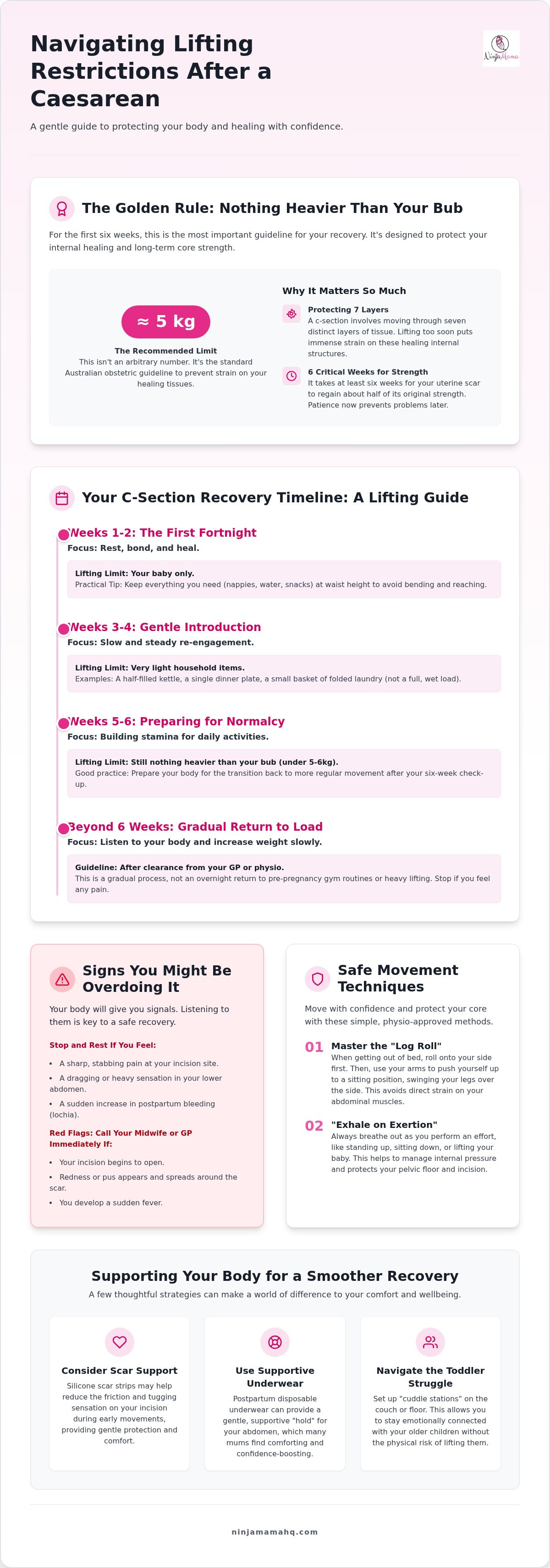
- Understand the golden "nothing heavier than your bub" rule and why the first six weeks are the most critical for your internal tissue healing.
- Follow a gentle, week-by-week timeline for navigating lifting restrictions after c-section surgery so you can return to daily life safely.
- Master the "Log Roll" and "Exhale on Exertion" techniques to move with confidence while protecting your core and incision site.
- Discover how silicone scar strips and supportive disposable underwear can help manage the tugging sensations that often come with early movement.
- Learn how to set up "cuddle stations" to stay connected with your older children without the physical risk of picking them up too soon.
What are the standard lifting restrictions after a C-section?
When you're discharged from an Australian hospital, your midwife will likely give you one golden rule: don't lift anything heavier than your baby. It sounds simple enough until you realise how much of your daily life involves a bit of muscle. Whether you had an elective procedure or an emergency birth, these lifting restrictions after c-section are non-negotiable for your safety. They are designed to protect your body while it performs the massive task of internal healing.
It's easy to forget that "lifting" isn't just about picking up a grocery bag. In the early weeks, this also includes any heavy pushing or pulling. This means you should skip the vacuuming and avoid pushing a heavy pram up steep hills. Even if you feel surprisingly good after a few days, your internal tissues are still very much in the early stages of repair. These rules apply to every mum, regardless of how her delivery journey unfolded.
The 5kg rule: Why it matters for your recovery
Most Australian obstetric guidelines recommend a strict 5kg weight limit for the first six weeks. This number isn't arbitrary. During a caesarean, a surgeon must carefully move through seven distinct layers, including skin, fat, and muscle fascia, to reach your bub. While your skin incision might look healed in a week or two, the deeper layers take much longer to regain their strength. A thorough C-section recovery requires time for the uterine scar to reach at least half of its original strength, which typically takes a minimum of six weeks.
Your body is incredibly resilient, but it needs a chance to knit those layers back together without being pulled apart by physical strain. Following the "nothing heavier than bub" rule is the gold standard for protecting your long-term core integrity. Many mums find that wearing gentle, supportive postpartum disposable underwear provides a sense of security and abdominal "hold" while navigating these early movement limits.
Signs you might be overdoing it
Listening to your body's subtle whispers is better than waiting for it to scream. If you feel a sharp, stabbing pain or a dragging sensation at your incision site, stop what you're doing immediately. These are clear signals that you're putting too much pressure on your repair work. You might also notice a sudden increase in lochia, which is your postpartum bleeding. If your discharge becomes brighter red or heavier after physical activity, it's a sign your body needs more rest and less movement.
If you experience any "red flag" symptoms, please call your midwife or GP. These include your incision opening, redness spreading around the scar, or a sudden fever. Protecting your scar with silicone scar patches can help reduce friction and tugging during necessary movements, but they aren't a substitute for the rest your body truly needs.
The C-section recovery timeline: A week-by-week lifting guide
Recovery after a caesarean isn't a sprint. It is a steady, intentional journey back to your full strength. While the initial lifting restrictions after c-section surgery can feel limiting, having a week-by-week plan helps you track your progress without the guesswork. Your body is doing incredible work behind the scenes, and following a structured timeline ensures you don't push too hard too soon.
During weeks one and two, your focus is entirely on "micro-lifting." This means your beautiful bub and perhaps a light nursing pillow. By weeks three and four, you can slowly introduce very light household items, such as a half-filled kettle or a single plate. As you approach weeks five and six, you are preparing your body for the transition back to more regular movement, though heavy lifting remains off the cards. Beyond the six-week mark, we move into a "return to load" phase. This is a gradual increase in weight rather than an overnight return to your pre-pregnancy gym routine.
The first fortnight: Prioritising rest and bub
In those first two weeks, your only job is to bond with your baby and heal. To make life easier, try to keep everything you need at waist height. This includes nappies, wipes, and snacks. Avoiding the need to bend or reach reduces the strain on your incision site significantly. Let your partner, friends, or family handle the nappy bag and the grocery run. This is a delicate time for your body, and at Ninja Mama, we truly understand the physical and emotional juggle of these early days.
The six-week milestone: Getting the "all clear"
Your six-week postnatal check-up with your GP or obstetrician is a big moment. They will check your abdominal wall and the integrity of your scar to ensure everything is knitting back together correctly. However, receiving the "all clear" doesn't mean you should immediately lift heavy furniture or sprint on a treadmill. Most C-section recovery guidelines suggest a cautious approach to exercise and heavy lifting for several months. In the Australian healthcare system, this is also the perfect time to ask for a referral to a women's health physio. They can provide a tailored plan to ensure your core and pelvic floor are ready for more weight. To keep yourself comfortable as you start moving more, many mums find our postpartum disposable underwear provides the gentle abdominal support needed for those first walks around the block.
Safe lifting techniques: How to move without the strain
Understanding the weight limits is only half the battle. The other half is mastering how you move your body during those necessary daily tasks. Even when you are strictly following lifting restrictions after c-section surgery, the way you pick up your bub or move from your bed can either support your healing or create unnecessary strain. It is about moving with intention rather than habit.
One of the most important movements you will learn is the "Log Roll." Instead of sitting straight up in bed, which puts immense pressure on your fresh abdominal incision, roll onto your side first. Use your arms to gently push yourself into a sitting position while keeping your knees together. This simple shift protects your core and prevents that sharp, "tugging" sensation that often causes anxiety in those first few weeks.
You might have heard about "bracing" your core, but for many new mums, this can actually be counterproductive. Sucking in your stomach or holding your breath creates high internal pressure that pushes down on your pelvic floor and out against your stitches. Instead, try the "Exhale on Exertion" method. By blowing out a gentle breath as you lift your baby, you naturally manage that internal pressure. It is a small change that makes a massive difference to your comfort levels.
The mechanics of a safe lift
When you need to pick up your bub from a cot or bassinet, keep them as close to your chest as possible. The further away an object is from your centre of gravity, the heavier it feels to your muscles and your scar. Use a wide stance with your feet at least shoulder-width apart to provide a stable base for your pelvis. Exhaling as you lift reduces intra-abdominal pressure, which protects both your internal stitches and your pelvic floor.
Functional swaps for common chores
Life doesn't stop just because you are recovering. You can still manage small tasks by using functional swaps that respect your body's limits. If you need to pick up a stray toy or a dropped dummy, use a "golfer’s lift" by extending one leg behind you for balance while leaning forward. This keeps your torso long and avoids crunching your midsection.
- Slide, don't lift: If you need to move a laundry basket, use your feet to gently slide it across the floor rather than picking it up.
- The pram challenge: A heavy pram is often the most difficult "essential" item. Ask a friend or your partner to handle the lifting into the car boot for the first six weeks.
- C-section comfort: Many mums find that applying silicone scar patches provides a helpful physical barrier that reduces friction against clothing while they practice these new movement techniques.
By focusing on these safe techniques, you can care for your baby and your home while feeling confident that you aren't ruining your long-term recovery. It's about being a "ninja" with your movements, moving smoothly and safely through your fourth trimester.
Supporting your body: Scar care and core stability
Moving your body after major abdominal surgery is just as much a mental challenge as it is a physical one. When you are navigating the lifting restrictions after c-section recovery, every movement can feel high-stakes. You might find yourself moving tentatively or holding your breath, worried that your incision isn't secure. This is where external support becomes your best friend. It provides the physical feedback your brain needs to feel safe while you perform essential tasks, like lifting your bub or reaching for a fresh nappy. When you feel "held," you move with more confidence and less fear.
Hygiene and comfort are paramount during this phase. Your surgical site needs a clean, breathable environment to knit back together properly. Choosing recovery gear that prioritises soft materials and intentional design ensures that you aren't adding irritation to an already sensitive area. By combining the right support with the safe movement techniques we have covered, you create a foundation for a smoother, more comfortable fourth trimester.
Why compression and support matter
There is a significant difference between aggressive abdominal binding and the gentle support your body craves during early recovery. While heavy binders can sometimes feel restrictive or even painful, wearing postpartum disposable underwear offers a soft, flexible barrier. It provides a gentle "hug" for your midsection without putting undue pressure on your internal repair work. Many mums find this external layer helps reduce the common, nagging fear of the incision opening during a sneeze or a lift. It acts as a protective shield between your sensitive skin and your regular clothing, allowing you to move with far more ease.
Scar management for better mobility
Your scar is the gateway to your future core stability. If the tissue feels tight, dry, or "tuggable," you will naturally avoid movements that engage your abdominal muscles. Using Ninja Mama C-section silicone scar patches helps create the optimal healing environment by keeping the area hydrated. This may help support a flatter, more flexible scar, which is essential for regaining your full range of motion.
Beyond the physical texture, scar care is about desensitisation. By protecting the site from constant friction against your clothes, you reduce those sharp, oversensitive "zinging" sensations. This makes it much easier to practice the "Log Roll" and other safe techniques without hesitation. For a truly holistic approach to your healing journey, you might find it helpful to explore our guide on the ultimate postpartum self-care kit. You aren't just healing a scar; you are rebuilding your confidence from the outside in.
Ready to feel more secure in your daily movements? Shop our C-section silicone scar patches today and give your recovery the premium, gentle support it deserves.
Navigating the "Toddler Struggle": Life with an older child
The hardest part of following lifting restrictions after c-section recovery isn't the laundry or the groceries. It's the moment your toddler reaches up with teary eyes and asks for a "big hug." The emotional toll of not being able to scoop up your eldest child can feel heavier than any physical weight. You might feel a surge of guilt or worry that your bond is slipping while you focus on the new bub. Please know that your child doesn't need to be lifted to feel loved. They just need you.
To navigate this, set up dedicated "cuddle stations" around your home. This might be a specific spot on the sofa with plenty of cushions or a cosy rug on the floor. Instead of you lifting them, encourage your toddler to climb up next to you for a "sit and snuggle." Explain the situation in age-appropriate terms. Many Aussie mums find that saying "Mummy has a big owie on her tummy" helps toddlers understand why things are a little different for now. It frames your recovery as something the whole family is helping with, rather than a rejection of their needs.
Practical hacks for toddler mums
Managing a toddler while healing requires a bit of "ninja" strategy to avoid accidental strain. Small adjustments to your daily routine can make a massive difference in how you manage those lifting restrictions after c-section surgery. Try these practical swaps to keep your recovery on track:
- Use the "step up" method: Keep a sturdy stool in the kitchen and by the car. Let your toddler practice their "big kid" skills by climbing into their high chair or car seat themselves.
- Ground-level changes: Move the nappy changing supplies to a mat on the floor. This eliminates the need to lift a wriggly toddler up to a high change table multiple times a day.
- Encourage "big helper" energy: Ask your toddler to bring you a nappy or find the baby's dummy. Involving them in the care of their new sibling fosters a sense of pride and keeps them engaged without needing to be carried.
When you have no choice: The "emergency" lift
We live in the real world, and sometimes a safety situation arises where you absolutely must lift your child. If your toddler is about to tumble down the stairs or run toward a busy road, your instinct will take over. If an emergency lift happens, don't panic. One accidental heavy lift doesn't necessarily mean you have ruined your long-term recovery. Take a moment to sit down and breathe as soon as the danger has passed.
Check your incision site for any new redness, oozing, or sharp pain. If you feel a "pop" or see any opening of the wound, call your midwife or GP immediately for a quick check-up. Most of the time, your body is resilient enough to handle a single moment of strain. Just use it as a reminder to slow down and ask for more help for the remainder of the day. You are doing an incredible job balancing the needs of two little ones while your body heals.
Embrace your recovery with confidence and care
Your journey through the fourth trimester is a time for bonding and gentle healing. By respecting the 5kg weight limit and mastering safe movement techniques like the Log Roll, you are giving your body the best possible chance to recover fully. Remember that following lifting restrictions after c-section surgery isn't about what you can't do; it's about protecting your long-term health so you can be the active, hands-on mum you want to be. Whether you are navigating life with a newborn or managing the toddler juggle, prioritising your wellbeing is the greatest gift you can give your family.
At Ninja Mama, we are dedicated to making this transition smoother. Our range is designed by an Aussie mum for Aussie mums, featuring soft, breathable fabrics that won't irritate your scar. Trusted by thousands of mums across Australia, our essentials provide the premium support you deserve during this delicate time. You don't have to navigate this path alone.
Shop the Ninja Mama C-Section Recovery range for ultimate comfort and take the next step in your healing journey with confidence. You are doing an incredible job, and we are right here with you.
Frequently Asked Questions
Can I lift my toddler 2 weeks after a C-section?
Managing lifting restrictions after c-section recovery means avoiding lifting your toddler for the first six weeks. Most toddlers weigh significantly more than the 5kg Australian safety limit. Lifting them too early puts pressure on your healing abdominal layers and scar. Instead of picking them up, invite them to sit next to you on the sofa or play together on a rug at ground level. This keeps your bond strong while protecting your recovery.
What happens if I lift something too heavy after my caesarean?
If you lift something too heavy, you may experience increased pain, sharp tugging at the incision, or a sudden surge in postpartum bleeding. In more serious cases, it could lead to wound dehiscence (the incision opening) or an incisional hernia. If you notice a sudden "pop" sensation, new swelling, or bright red bleeding after a heavy lift, it is important to rest immediately and contact your midwife or GP for a check-up.
How long do lifting restrictions last after a C-section in Australia?
Standard lifting restrictions after c-section surgery in Australia usually last for six weeks. This is the time required for your uterine scar and abdominal tissues to regain enough strength to handle more than the weight of your baby. Your obstetrician or GP will check your progress at your six-week postnatal appointment. Even after this milestone, you should return to your normal activities gradually rather than jumping straight back into heavy household tasks or exercise.
Can I push a pram after a C-section?
You should avoid pushing a heavy pram for the first two to three weeks, especially on hills or uneven surfaces. Pushing involves your core muscles more than you might realise. Start with very short, flat walks once you feel comfortable moving around the house. If you feel any dragging or stinging at your scar site, it is a sign to stop. Many mums find that wearing supportive disposable underwear makes these walks feel more secure.
Is it okay to lift a basket of laundry 4 weeks postpartum?
A full basket of wet laundry is surprisingly heavy and usually exceeds the recommended 5kg limit at four weeks postpartum. It is better to wait until after your six-week check-up before returning to these chores. If you must do laundry, try washing very small loads or sliding the basket across the floor with your feet instead of lifting it. Asking for help with the heavy lifting during this phase is essential for your internal healing.
Why does my C-section scar sting when I lift things?
Stinging is quite common as the tiny nerve endings around your incision site begin to knit back together. When you lift, the skin and underlying tissues stretch, which can cause a sharp or burning sensation. It can also be caused by your clothing rubbing against the sensitive scar. Using silicone scar patches can help by providing a protective barrier and keeping the area hydrated, which often reduces that uncomfortable "tugging" or stinging feeling during movement.
How do I know if I have pulled an internal stitch?
Pulling an internal stitch often feels like a sharp, localised pain that doesn't go away with rest. You might also notice new swelling, a lump near the incision, or redness that seems to be spreading. While your body is designed to heal, these symptoms need a professional eye. If you are worried that you have overdone it, always reach out to your healthcare provider to ensure your internal layers are still secure and healing correctly.
When can I return to heavy lifting at the gym (like CrossFit or weights)?
Most experts recommend waiting until at least 12 weeks before returning to high-impact exercise like CrossFit or heavy weightlifting. Your body needs time to rebuild core and pelvic floor strength after major surgery. It is highly recommended to see a women's health physiotherapist before you start. They can assess your abdominal wall and provide a tailored "return to sport" plan, ensuring you don't experience issues like prolapse or persistent abdominal separation later on.

Article by
Louise Beever
Louise Beever is the founder of Ninja Mama, an Australian postpartum recovery brand focused on creating premium, practical recovery essentials for new mothers. Since launching Ninja Mama in 2018, Louise has worked closely with thousands of postpartum women and healthcare retailers to better understand the realities of recovery after birth. Her work focuses on postpartum preparation, recovery support, and improving awareness around the fourth trimester.
Remember Mamas
The information provided in this article is intended for general educational and informational purposes only and should not be considered medical advice. Always seek guidance from your doctor, midwife, lactation consultant, or qualified healthcare professional regarding your individual circumstances, pregnancy, birth, or postpartum recovery.