
What if that "disconnected" feeling in your midsection isn't a sign that you're broken, but that your body is simply in the middle of a massive architectural recalibration? It's completely normal to look in the mirror or try to lift your bub and wonder exactly what happens to your core after pregnancy? You might feel a bit like a stranger in your own skin, especially if you're dealing with a niggle in your lower back or worrying about that gap between your abdominal muscles.
We understand that the pressure to "bounce back" can feel heavy, but your body deserves a much more nurturing approach. We're here to help you move from anxiety to a sense of prepared calm by explaining how your muscles and pelvic floor actually recalibrate after birth. It's about supporting your body’s natural healing process rather than rushing it.
This guide walks you through the realistic timeline for core recovery and explains how to safely check for diastasis recti at home. You'll also find practical, gentle ways to support your healing while you focus on the beautiful, busy work of caring for your newborn.
Key Takeaways
- Learn about the internal shift as your organs find their original homes and your uterus begins the process of shrinking back down.
- Discover the truth about what happens to your core after pregnancy, including why abdominal separation is a natural part of making room for your bub.
- Understand the "canister" model of your core and why the pelvic floor is the essential base that needs gentle support during recovery.
- Find out why the Fourth Trimester is for gentle activation and how your daily posture can be your secret weapon for healing.
- Get practical tips for reducing abdominal pressure during everyday tasks to support your body's natural recovery process.
The Postpartum Core Transformation: What to Expect in the First Few Weeks
The moment your bub arrives, your body begins one of the most incredible physical shifts imaginable. You might expect to feel lighter immediately, but many mums describe a strange, jelly-like sensation instead. If you're wondering exactly what happens to your core after pregnancy, the answer starts with a massive internal shuffle. Your body is moving from a state of maximum expansion to a period of rapid recalibration, and it's a process that deserves both your patience and your awe.
To better understand this concept, watch this helpful video:
The Uterus and the 'After-Birth' Pooch
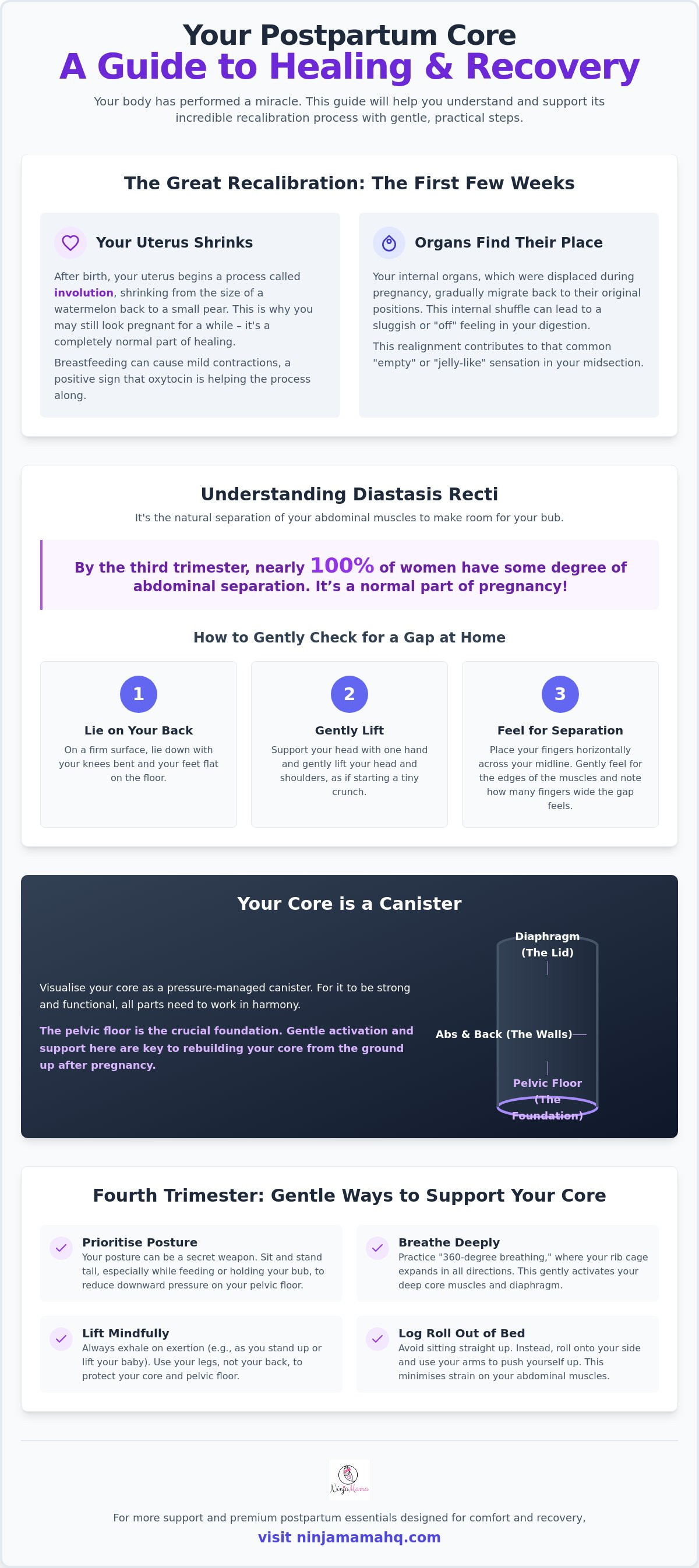
Your uterus has spent nine months expanding from the size of a small pear to a large watermelon. The second the placenta is delivered, it begins a process called involution. This is the natural shrinking of the uterus back to its pre-pregnancy size. Because this takes time, it's completely normal to still look about six months pregnant for a while after delivery. This "pooch" isn't just about body fat. It's actually the physical presence of your uterus and organs as they begin to settle. Many women find that breastfeeding triggers mild, period-like contractions. These are actually a wonderful sign that oxytocin is helping your uterus tighten and shrink. It's okay to feel a mix of emotions as you look at your new reflection. Your body has just performed a miracle, and this soft, transitional phase is a vital part of your recovery journey.
Organ Realignment: Finding Their Place Again
While your uterus is busy shrinking, your other internal organs are also on the move. Throughout your pregnancy, your stomach and intestines were gradually displaced and squished upwards to accommodate your growing bub. Once you've given birth, these organs don't simply snap back into place. They have to navigate their way back to their original positions. This internal migration is why your digestion might feel a bit sluggish or "off" during the first fortnight. You might also experience that famous "empty" feeling in your midsection. Postpartum core recalibration is the natural, necessary process of internal realignment and hormonal settling. During this time, hormones like Relaxin continue to circulate, keeping your joints and connective tissues soft. This softness is why being gentle with yourself is so important, especially if you are mindful of Diastasis recti. Sipping on raspberry leaf tea is a gentle way many mums choose to support their uterine health during this transition.
Understanding Diastasis Recti: Why Your Muscles Separate
One of the most common things women notice when wondering what happens to your core after pregnancy is a soft, vertical gap down the centre of their stomach. This is Diastasis Recti. While the name sounds a bit clinical, it's actually a completely natural part of the journey. In fact, research from 2026 suggests the overall incidence of some degree of separation can be as high as 89.0%. By the third trimester, nearly 100% of women have some separation of the linea alba, which is the connective tissue between your six pack muscles, to make room for your growing bub. For many mums, this gap closes naturally as the body recalibrates, but for others, it requires mindful movement to regain tension. The goal isn't just closing the gap. It's about ensuring the tissue is springy and functional again.
How to Safely Check Your Own Abdominal Gap
You can check your own progress at home once you feel ready. Follow these simple steps to get a sense of how your muscles are knitting back together:
- Step 1: Lie on your back on a firm surface with your knees bent and feet flat on the floor.
- Step 2: Gently lift your head and shoulders as if you're starting a very small crunch. Place your fingers horizontally across your midline, just above your belly button.
- Step 3: Feel for the edges of the muscles. Note how many fingers wide the gap is. Is it one, two, or three fingers wide?
- Step 4: Check the depth of the gap. Does the tissue feel firm, like the tip of your nose or your chin? Or does it feel soft and deep, like the inside of your cheek?
When to See a Women's Health Physio
While some separation is normal, there are times when professional guidance is the best way to support your recovery. If your gap remains wider than two or three fingers after the eight week mark, it's a good idea to book an appointment with a Women's Health Physio. You should also seek advice if you notice "doming" or "coning." This is when a ridge or bulge appears along your midline when you try to sit up or lift your baby. Your six week GP check is a brilliant starting point for your recovery journey. Your doctor can provide an initial assessment and a referral if needed. If you're looking for evidence based advice on Exercise after pregnancy, a specialist physio can help you create a plan that feels safe and empowering. They'll ensure you're building functional strength without putting unnecessary stress on your healing tissues.
The Pelvic Floor: The Foundation of Your Post-Pregnancy Core
Think of your core as a premium canister. The diaphragm is the lid, your abdominal muscles are the sides, and your pelvic floor is the beautiful, supportive base. When you start to wonder what happens to your core after pregnancy, you have to look at the entire system as a whole. Pregnancy and birth, whether you had a vaginal delivery or a C-section, put significant pressure on the base of this canister. A study from 2025 found that 50% of women experience one or more types of pelvic floor dysfunction within ten years of giving birth. If that base is feeling a bit compromised, it's much harder for your abdominal muscles to knit back together properly. Managing intra-abdominal pressure is the secret to protecting both your tummy and your pelvic floor during this season of healing.
Why the Pelvic Floor is Your Core's Best Mate
A strong, functional base provides the tension your abdominal muscles need to heal. Without that support from below, your core lacks the stability it needs to function. This weakness often leads to common postpartum challenges, like light bladder leakage. Recent data from May 2025 shows that 43.9% of women experience urinary incontinence after birth. It's difficult to feel "connected" to your muscles when you're dealing with physical discomfort or sensitivity. Many women find that using perineal cooling pads provides the immediate relief and comfort needed to help them feel more in tune with their bodies. This comfort makes it much easier to begin gentle pelvic floor exercises and rebuild that essential foundation.
Breathing Your Way to a Stronger Core
Your recovery journey doesn't require a gym membership. It starts with your breath. The "Exhale on Effort" rule is a simple but powerful tool for every new mum. Try to breathe out whenever you lift your bub, move the nappy bag, or even push yourself up from the bed. This small change helps manage internal pressure and prevents it from pushing down on your pelvic floor or out against your abdominal wall. You can practice diaphragmatic breathing anywhere, even while nursing or resting during a nap. Connection breaths link the diaphragm to the pelvic floor, teaching your core system to work in harmony once again. It's a gentle way to remind your body that it's safe, supported, and capable of healing at its own pace.
Rebuilding Strength: Gentle Movement in the Fourth Trimester
The Fourth Trimester isn't the time for high-intensity gym sessions or "shredding" programs. It's a sacred window for healing and gentle activation. When you consider what happens to your core after pregnancy, you realise your muscles have been through a marathon. They need a recovery plan, not a boot camp. Your secret weapon during these early weeks isn't a piece of gym equipment. It's your posture. How you sit, stand, and hold your bub determines how your core heals. Avoid "crunch" movements or heavy lifting in the early weeks. These movements create too much internal pressure on that soft linea alba we discussed earlier.
Walking is the perfect first exercise. Start with short, flat strolls around the block to get your blood flowing and your spirit lifted. It’s a gentle way to reconnect with your body without overdoing it. Listen to your body and rest whenever you feel the need. This is a season for nurturing, not pushing.
Taming the 'Breastfeeding Hunch'
Have you noticed yourself slouching over while nursing? This "breastfeeding hunch" is more than just a source of back pain. It keeps your abdominal muscles in an overstretched, weak position. This makes it much harder for your core to recalibrate properly. Use plenty of pillows to bring your bub up to your breast rather than leaning down to them. If your maternity bras are feeling a bit tight, using bra extenders can provide the breathing room you need to stand taller. Try a quick posture reset after every nappy change. Roll your shoulders back, tuck your chin slightly, and take a deep, mindful breath.
Safe Movements for C-Section Mums
Understanding what happens to your core after pregnancy when you've had a C-section is key to a safe recovery. You're healing from major abdominal surgery, which requires an extra layer of patience. Protecting your incision is the first priority. When getting out of bed, use the "log roll" technique. Roll onto your side first, then use your arms to push yourself up. This prevents your deep core muscles from straining against the surgical site. Many women find that silicone scar strips are helpful for supporting the skin and underlying tissue as it heals. These strips create a protective environment that can help the scar feel more comfortable as you begin to move more.
Ready to give your body the premium support it deserves? Browse our Postpartum Recovery Bundles for a curated selection of essentials designed for your healing journey.
Support and Care: Practical Tools for a Healing Core
Recovery is a holistic process. When you feel comfortable and clean, your body can finally divert its energy away from stress and towards actual healing. Often, we get so focused on the big questions like what happens to your core after pregnancy that we forget the small, daily moments that impact our recovery. Every time you twist to reach for a nappy or strain during a bathroom visit, you're putting pressure on those recalibrating muscles. By building a dedicated recovery station, you keep your essentials within arm's reach. This simple organisation reduces unnecessary bending and twisting while your connective tissues are still soft and vulnerable.
Why Hygiene Matters for Core Healing
Avoiding strain on the toilet is a total game-changer for your core. We often don't realise how much we tense our abdominal wall when we're uncomfortable or feeling "blocked" after birth. Using an upside down peri bottle allows you to stay relaxed, preventing those sharp spikes in abdominal pressure that can hinder the healing of your muscles. The Ninja Mama peri bottle becomes a true best friend for post-birth bathroom trips, ensuring you keep the area clean without the need for harsh wiping or tensing. Keeping your perineal or incision area clean reduces inflammatory stress on your system, letting your body focus on knitting those deep layers back together properly.
Creating Your Prepared Calm
Investing in a postpartum recovery kit is about more than just products. It's about creating a sense of prepared calm. When you have everything you need on hand, the mental and physical load on you decreases significantly. Nutrition also plays a massive role in tissue repair. Sipping on organic lactation tea or enjoying a lactation chocolate drink provides the hydration and energy your body craves during this intense season of change. These small acts of self-care provide the building blocks for long-term strength and vitality.
Your body did something absolutely incredible. It grew and birthed a human life, and that kind of magic takes time to settle. As you navigate the reality of what happens to your core after pregnancy, remember to give yourself the same grace you give your new bub. You aren't "bouncing back"; you're moving forward into a new, stronger version of yourself. Take the time you need to find your new centre, knowing that with the right support, your body is fully capable of this beautiful recalibration.
Finding Your New Centre with Confidence
You now have a clearer picture of the incredible architectural shift your body undergoes during and after birth. From the internal migration of your organs to the natural stretching of your abdominal muscles, understanding What Happens To Your Core After Pregnancy? is the first step toward a recovery built on kindness rather than pressure. By prioritising the health of your pelvic floor and practicing gentle, mindful movement, you give your connective tissues the space they need to regain their natural tension and strength.
As an Australian owned and operated brand, Ninja Mama is here to be your reassuring companion through every stage of the Fourth Trimester. Our range offers evidence-aware solutions designed by a mum who has been there and understands the physical and emotional needs of this transition. You deserve to feel supported, comfortable, and empowered as your body recalibrates.
Ready to prioritise your wellbeing? Build your ultimate recovery kit with Ninja Mama’s curated bundles and embrace your healing journey with the practical care you need. Your body has performed a miracle, and now it is time to give it the grace and support it deserves. You are doing an amazing job, mama.
Frequently Asked Questions
How long does it take for your core to feel normal after pregnancy?
Foundational core recovery typically takes three to six months, while a return to full pre-pregnancy function and fitness often takes six to twelve months. This timeline varies for every mama based on your individual birth experience and activity levels. It's helpful to remember that what happens to your core after pregnancy is a gradual recalibration, not an overnight snap-back. Patience is your best friend during this first year.
Can I fix diastasis recti years after having a baby?
Yes, you can absolutely improve the function and appearance of your abdominal wall years after giving birth. The connective tissue of the linea alba remains capable of responding to targeted, mindful movement at any stage. Working with a Women's Health Physio can help you rebuild the necessary tension and "springiness" in your midsection, even if your youngest bub is already in primary school. It is never too late to start.
Is it safe to do sit-ups or planks postpartum?
Traditional sit-ups and planks are generally not recommended in the early months of recovery. These movements create significant intra-abdominal pressure that can strain your healing muscles and pelvic floor. You should wait until you have been cleared by a healthcare professional and can perform gentler movements without any "coning" or "doming" before progressing to high-pressure exercises. Focus on foundational breathing first.
What does 'coning' or 'doming' look like on my stomach?
Coning or doming appears as a vertical ridge or "bread loaf" shape protruding along the centre of your stomach during movement. This happens when your internal pressure isn't being managed correctly, causing the midline tissue to bulge outward. If you notice this while sitting up or lifting your bub, it's a sign to scale back the intensity and focus on your "exhale on effort" breathing technique.
Does wearing a postpartum belly wrap actually help my core?
A belly wrap can provide wonderful sensory feedback and a sense of "held" comfort during the early weeks of movement. While it doesn't "fix" the muscles or force them back together, it can help you feel more supported while your body recalibrates. Use it as a temporary tool for comfort and proprioception rather than a permanent crutch for core strength. Your internal muscles still need gentle, active engagement to heal.
Can I have diastasis recti after a C-section?
Yes, you can certainly experience abdominal separation after a C-section birth. Diastasis recti is primarily caused by the gradual expansion of the uterus and the stretching of the abdominal wall over nine months of pregnancy. Because what happens to your core after pregnancy is driven by this long-term growth, the method of delivery doesn't prevent the separation from occurring. C-section mums often need extra focus on gentle, scar-safe recovery movements.
How do I know if my core weakness is actually a pelvic floor issue?
Core weakness and pelvic floor dysfunction are usually two sides of the same coin because they belong to the same canister system. If you experience symptoms like urinary incontinence, a heavy sensation in your pelvis, or persistent lower back pain, your pelvic floor likely needs specific attention. A 2025 study found that 50% of women experience some form of pelvic floor dysfunction within a decade of birth, so these issues are incredibly common.
What are the best gentle exercises to start with in the first week?
Diaphragmatic breathing and very gentle pelvic floor activations are the safest ways to begin your recovery in the first week. These "connection breaths" allow you to subtly engage your deep core without putting any physical strain on your incisions or perineum. Focus on small, mindful movements that help you feel "connected" to your body again while you rest and bond with your new arrival. Avoid any movements that cause pain or pressure.

Article by
Louise Beever
Louise Beever is the founder of Ninja Mama, an Australian postpartum recovery brand focused on creating premium, practical recovery essentials for new mothers. Since launching Ninja Mama in 2018, Louise has worked closely with thousands of postpartum women and healthcare retailers to better understand the realities of recovery after birth. Her work focuses on postpartum preparation, recovery support, and improving awareness around the fourth trimester.
Remember Mamas
The information provided in this article is intended for general educational and informational purposes only and should not be considered medical advice. Always seek guidance from your doctor, midwife, lactation consultant, or qualified healthcare professional regarding your individual circumstances, pregnancy, birth, or postpartum recovery.